
Views: 0 Author: Site Editor Publish Time: 2026-08-24 Origin: Site
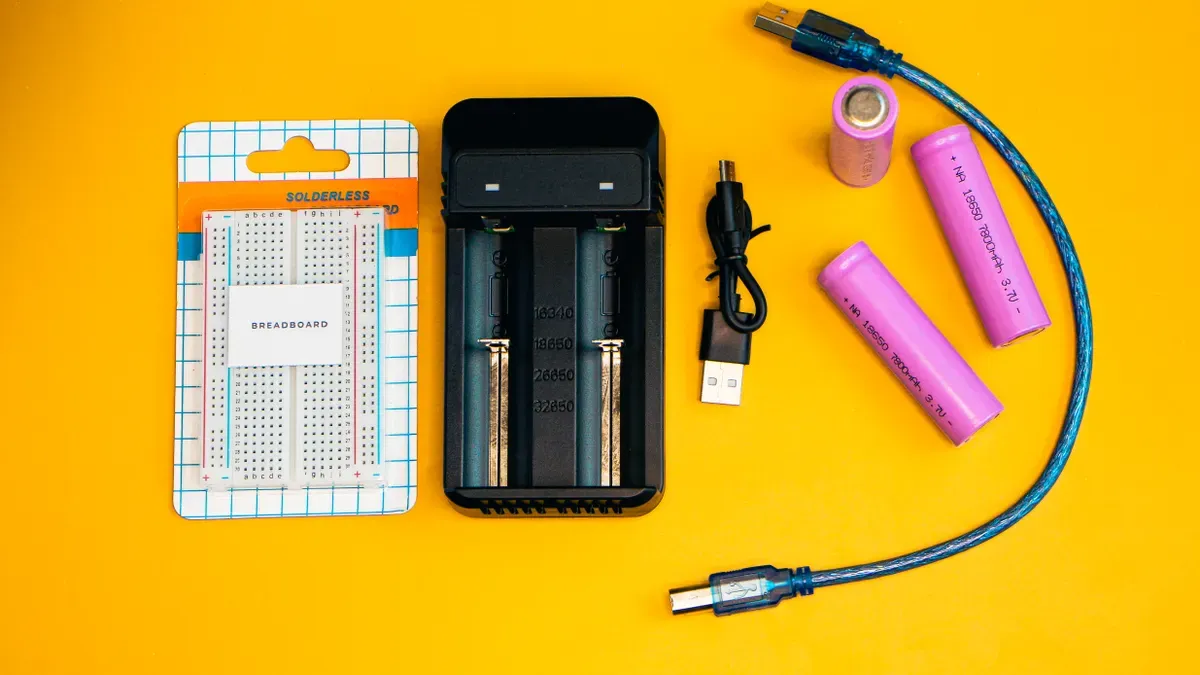
Image Source: pexels
To charge a lithium cell safely, you must use a dedicated lithium charger that follows a Constant Current (CC) and Constant Voltage (CV) profile. Using the wrong charger or settings creates real dangers. Overcharging beyond 4.2V per cell can cause lithium plating on the anode, leading to short circuits and excessive heat.
Operating a lithium-ion battery outside its recommended voltage range can pose significant safety risks. Overcharging or deep discharging can lead to overheating, capacity degradation, and, in extreme cases, thermal runaway—a condition where the battery overheats and may catch fire.
Follow two golden rules. Never exceed the maximum voltage of 4.2V per cell. Never use a lead-acid charger. This guide explains how to charge lithium cell properly, covering charging stages, charger selection, and safety practices for longevity.
Always use a special lithium charger that follows the CC/CV method for safe charging.
Never go above 4.2 volts for each cell; charging too much can cause lithium plating and short circuits.
Don't use lead-acid chargers. Their float mode can overcharge lithium cells and cause a fire.
Charge your lithium cell only when the temperature is between 0°C and 45°C. This helps prevent damage and stops thermal runaway.
Keep lithium cells at 40–50% charge to make them last longer and hold their capacity.
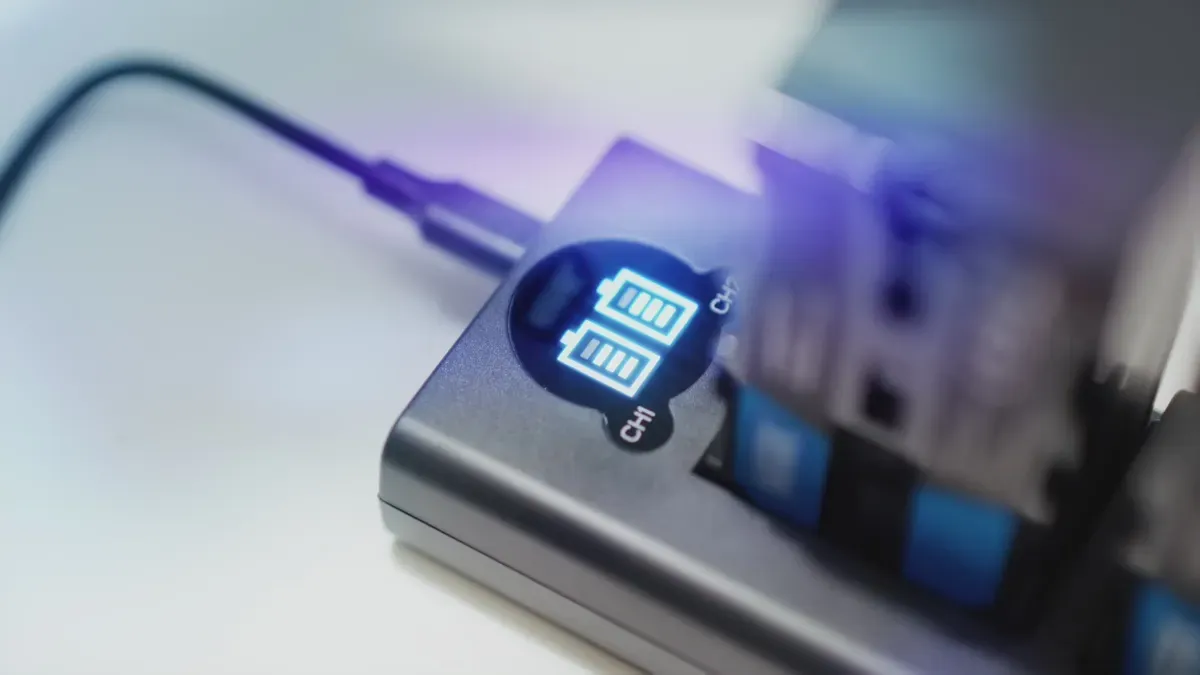
Image Source: pexels
The CC/CV profile stands for Constant Current and Constant Voltage. This two-stage process is the foundation of safe lithium charging. You need to understand both stages to charge your cells correctly. The charger switches between stages on its own, but knowing the process helps you make smarter decisions. Let us go through each stage.
The CC stage sends a steady current to your cell. This current flows at a fixed rate until the cell hits its maximum voltage. For standard Li-ion cells, that maximum voltage is 4.2V per cell. The tolerance is ±50mV. The charger applies full current during this phase. The voltage rises steadily as the cell accepts charge.
Here are the key parameters for a standard Li-ion cell:
Parameter | Value |
|---|---|
Chemistry | Li-ion (LiPo, LiCoO₂) |
Nominal Voltage (per cell) | 3.6-3.7V |
Max Charge Voltage | 4.2V |
Charge Profile | 2 Stage CC-CV |
You must pick the correct current rate for your battery chemistry. Different chemistries need different charge rates. The table below shows the typical and maximum rates:
Battery Chemistry | Typical Charge Rate | Maximum Charge Rate |
|---|---|---|
Lithium Manganese Oxide | 0.7–1C | 3C |
Lithium Iron Phosphate | 0.3C | 1C |
Lithium Nickel Manganese Cobalt Oxide | 0.7C | 1C |
Lithium Titanate | 1C | 5C |
Most small batteries in portable devices limit charging to 1C. You should always follow the manufacturer guidelines for your specific cell. The CC stage ends when the voltage hits 4.2V. At that point, the charger switches to the CV stage. This transition happens automatically in a proper lithium charger.
The CV stage holds the voltage constant at 4.2V. The charger then gradually reduces the current. This prevents overcharging while allowing the cell to reach full capacity. The current drops as the cell becomes full. You might notice the charging slows down during this phase.
You need to know when charging is complete. The charger monitors the current during the CV stage. Charging terminates when the current falls to a specific threshold. This threshold is called the termination current.
Termination current threshold (ITERM): Typically set to 0.1 × C (i.e., 0.1C) to end the Constant Voltage (CV) stage in lithium-ion charging. This is the industry-standard value used to determine when the battery is fully charged.
So for a 2000mAh cell, charging stops when the current drops to 200mA. You calculate this as 0.1 times the capacity. This ensures the cell is fully charged without overcharging. The charger cuts off power at this point. The cell is now ready for use.
For LiFePO4 batteries, a three-stage approach is common. Stage 1 often uses a lower current rate of 0.1C to 0.3C. This gentle start helps protect the chemistry. The rest of the process follows a similar pattern but with different voltage limits. LiFePO4 cells typically have a lower maximum voltage around 3.65V per cell.
Understanding the CC/CV profile is essential for safe charging. When you know how to charge lithium cell correctly, you avoid the risks of overcharging. The CC stage delivers the bulk of the energy. The CV stage tops off the cell safely. The termination current ensures you stop at the right time.
Always use a charger that follows this profile. A dedicated lithium charger handles both stages automatically. You simply set the correct voltage and current limits. The charger does the rest. This approach keeps your cells safe and extends their lifespan. Now you know how to charge lithium cell using the proper stages. Next, you need to know how to choose the right charger for your specific battery.
You must use a charger made for lithium chemistry. A lead-acid charger works differently. It uses many steps and has a float mode. Float mode keeps sending a small current after the battery is full. For a lithium cell, that steady current causes overcharging. Overcharging creates dendrites inside the cell. Dendrites are tiny metal spikes that can poke through the separator. This causes a short circuit. The result can be thermal runaway, fire, or explosion.
The table below shows the key differences.
Feature | Lithium (CC/CV) | Lead-Acid (Multi-Stage) | Consequence of Mixing |
|---|---|---|---|
Post-Full Charge | Completely cuts off current | Enters Float, continues supplying power | Overcharge, dendrite formation, shortened lifespan |
Voltage Limit | Strict, error < 0.05V | Allows fluctuations, high-voltage pulses | Pulses can destroy BMS instantly |
Recharge Behavior | Restarts only when voltage drops | Always connected, maintains small current | High voltage for extended periods, prone to thermal runaway |
A lead-acid charger also has a desulfation mode. It sends high-voltage pulses between 16V and 20V. These pulses can burn out your battery's BMS. Even if the BMS survives, the pulses force dendrite growth. This leads to internal short circuits and explosion.
The algorithm mismatch is another danger. A lead-acid charger cannot tell when your lithium cell is full. It forces overcharging. This causes permanent damage. Heat builds up. The temperature rise can trigger thermal runaway.
A lithium-specific charger avoids all these problems. It lets you pick the chemistry type. This sets the best voltage and charging profile. It automatically shuts off when the cell is full. There is no float stage. It has wake-up capability to recover over-discharged batteries. It keeps strict voltage precision with error under 0.05V.
You must match the charger settings to your battery's chemistry and capacity. The voltage limit is the most critical setting. Standard Li-ion cells charge to 4.2V per cell. NMC cells also use 4.2V. LFP cells use a lower maximum of 3.65V. High-voltage NMC cells can go to 4.35V. Check the manufacturer's datasheet. Never exceed the specified voltage.
The charge voltage directly affects capacity.
Charge Voltage per Cell | Capacity at Cut-off | Charge Time | Capacity with Full Saturation |
|---|---|---|---|
3.80V | ~40% | 120 min | ~65% |
3.90V | ~60% | 135 min | ~75% |
4.00V | ~70% | 150 min | ~80% |
~80% | 165 min | ~90% | |
4.20V | ~85% | 180 min | 100% |
Charging to 4.10V gives you about 90% capacity. This takes less time and reduces stress on the cell. Many choose this for longer battery life.
The charge current is also important. The advised rate for energy cells is 0.5C to 1C. Manufacturers recommend 0.8C or less. This is how to charge lithium cell properly. Full charge occurs when the voltage reaches the threshold and the current drops to 3% of the rated current. The switch from CC to CV must happen exactly at the voltage threshold. This prevents lithium plating.
Temperature matters too. Never charge below 0°C. Normal charging happens between 0°C and 45°C. Charging shuts down above 50°C. The cell temperature must stay under 45°C during the CC phase. Cold charging increases lithium plating risk.
Your charger relies on the Battery Management System (BMS) in the battery. The BMS monitors voltage and prevents overcharge. The charger must work with the BMS to keep everything safe.
Now you know how to charge lithium cell correctly. You understand the importance of a lithium-specific charger. You know the exact voltage and current limits. This knowledge keeps your batteries safe and extends their life.
A cell drained below 2.5V is very dangerous. When voltage falls under about 2.0V, the copper foil on the anode starts to dissolve. When you recharge, this copper re-plates in random ways. That can cause internal short circuits. These shorts may lead to thermal runaway. Internal resistance also climbs sharply near zero charge. This causes fast heating when you try to charge.
Never charge a deeply drained cell with a regular charger. Instead, use a recovery mode that sends a very small current, usually under 0.1C. This gentle method reduces stress on the damaged cell. The recovery process has three steps:
Detection: The charger sends a low-current probe to check the battery's state. Smart circuitry tells if the cell can be saved or if it has failed.
Gentle Activation: If the cell is okay, the charger applies a tiny charging current. This avoids overheating or permanent harm.
Transition to Normal Charging: Once voltage passes a safe level, the charger switches to standard CC/CV mode.
Before trying recovery, check the cell by sight. If you see swelling, leaks, cracks, or holes, recycle it right away. Work in an open area with safety gear. Keep a fire extinguisher close. If the battery shows no response within 30 minutes, stop and recycle it.
A cell harmed by over-discharge never returns to normal. Even after a successful recovery, it stays permanently weakened and needs close watching for its whole life. The maker expects any recovered cell to be part of a pack watched by a full-featured BMS.
Temperature controls safe charging. The hard limit for charging is 0°C to 45°C (32°F to 113°F). The best range is between 10°C and 40°C. Never charge below 0°C. At freezing temperatures, slower diffusion on the anode causes metallic lithium plating. This leads to lasting damage and short-circuit risk.
Parameter | Safe Range |
|---|---|
Charging (absolute limit) | 0°C to 45°C (32°F to 113°F) |
Charging (recommended optimal) | 10°C to 40°C |
Discharging (usage) | -20°C to 60°C (-4°F to 140°F) |
Long-term storage | 15°C to 25°C (59°F to 77°F) |
Charging above 45°C causes electrolyte breakdown, gas buildup, and swelling. These issues raise thermal runaway risk. Some special cells allow slower charging below freezing, but normal cells do not.
Follow these safety steps when charging:
Charge devices on the floor, away from things that burn.
Plug chargers straight into wall outlets, not extension cords.
Never charge in bedrooms or near exits.
Watch batteries for smells, shape changes, leaks, or odd sounds.
Stop using batteries that show any of these warning signs.
Avoid long high-voltage float charging. This practice harms the cell and speeds up capacity loss. Knowing how to charge lithium cell safely means respecting both voltage limits and temperature limits. Your care prevents dangerous failures.
How you store your lithium cells matters as much as how you charge them. Proper storage habits prevent capacity loss and extend the battery's useful life. You already know how to charge lithium cell safely. Now you need to master storage.
The state of charge at storage time determines how much capacity you keep. Storing at full charge stresses the cell. High voltage accelerates chemical reactions inside the battery. These reactions consume the active materials that store energy.
For lithium-based batteries, the recommended storage state-of-charge is 40%, as this level (approximately 3.82V/cell at room temperature) yields amazing longevity for most Li-ion systems.
The data below shows what happens when you ignore this advice:
Storage Condition | Capacity Retained After 1 Year |
|---|---|
25°C, 40% charge | 96% |
25°C, 100% charge | 80% |
40°C, 40% charge | 85% |
40°C, 100% charge | 65% |
Storing at 100% charge costs you 16% capacity at room temperature. At 40°C, the loss jumps to 20%. Heat and full charge together destroy your battery's longevity.
A regular Li-ion should not remain at the high-voltage ceiling of 4.20V/cell for an extended time. Exposing the battery to high temperature and dwelling in a full state-of-charge for an extended time can be more stressful than cycling.
Aim for 40–50% charge before long-term storage. This range balances electron distribution across both terminals. It prevents the stress of high voltage while avoiding the dangers of deep discharge.
Storage requires periodic attention. You cannot simply set a battery aside and forget it. Self-discharge slowly drains the cell over time. Without intervention, the voltage can drop to harmful levels.
Charge or discharge the battery to approximately 50% of capacity before storage.
Recharge to 50% at least once every six months to compensate for self-discharge.
Remove the battery and store it separately from the product.
Maintain storage temperature between 5°C and 20°C (41°F and 68°F); higher temperatures reduce storage life.
Inspect stored batteries regularly. Check for swelling, leaks, cracks, or other physical damage. Use non-conductive containers. Keep batteries away from metal objects and each other. Ensure proper ventilation to dissipate any heat buildup.
The optimal state of charge for maximizing cycle life is 50% SoC. At this level, electrons distribute equally on the positive and negative terminals. This balance prevents permanent capacity loss. For long-term maintenance, cycle the battery every 6–12 months: charge to 100% SoC, discharge to 100% DoD, then charge back to 50% SoC for storage.
Avoid deep discharges and extreme temperatures. These two factors shorten cycle life more than anything else. Your careful storage habits will reward you with years of reliable service.
You now know how to charge lithium cell safely. Always use a lithium-specific charger. Follow the CC/CV profile. Respect the voltage limit of 4.2V per cell. These three steps protect your battery from damage.
Never use a lead-acid charger. Never charge below 0°C. Never float charge. These actions cause permanent harm.
Store your cells at 20-80% charge. Avoid full discharges. These habits extend battery life significantly. You will enjoy years of reliable service.
Follow these guidelines. You can charge your lithium cells safely and efficiently. Your batteries will perform well and stay safe for their entire lifespan.
No. Phone chargers and USB ports do not follow the CC/CV profile. They lack voltage precision. They cannot terminate charging correctly. Use a dedicated lithium charger only.
Your charger stops automatically. It monitors the current during the CV stage. Charging ends when current drops to 0.1C. For a 2000mAh cell, that means 200mA. The charger cuts off power at this point.
No. Lithium cells do not tolerate float charging. Leaving the battery connected keeps voltage high. This stresses the cell and causes capacity loss. Unplug the charger once charging completes. Never leave batteries unattended while charging.
No. Swelling means internal damage. The cell has formed gas from electrolyte breakdown. Do not charge it. Do not puncture it. Recycle it immediately. A swollen battery poses a fire risk.