Low Temperature LiPo Battery

Reliable Performance Down to -40°C
 
ZERNE low temperature LiPo batteries are engineered for reliable discharge performance in extreme cold environments down to -40°C, with multiple capacities, cell sizes, and custom options available for OEM applications.
 
You are here: Home » Battery Cells » Low temperature Battery

What Is a Low Temperature LiPo Battery?

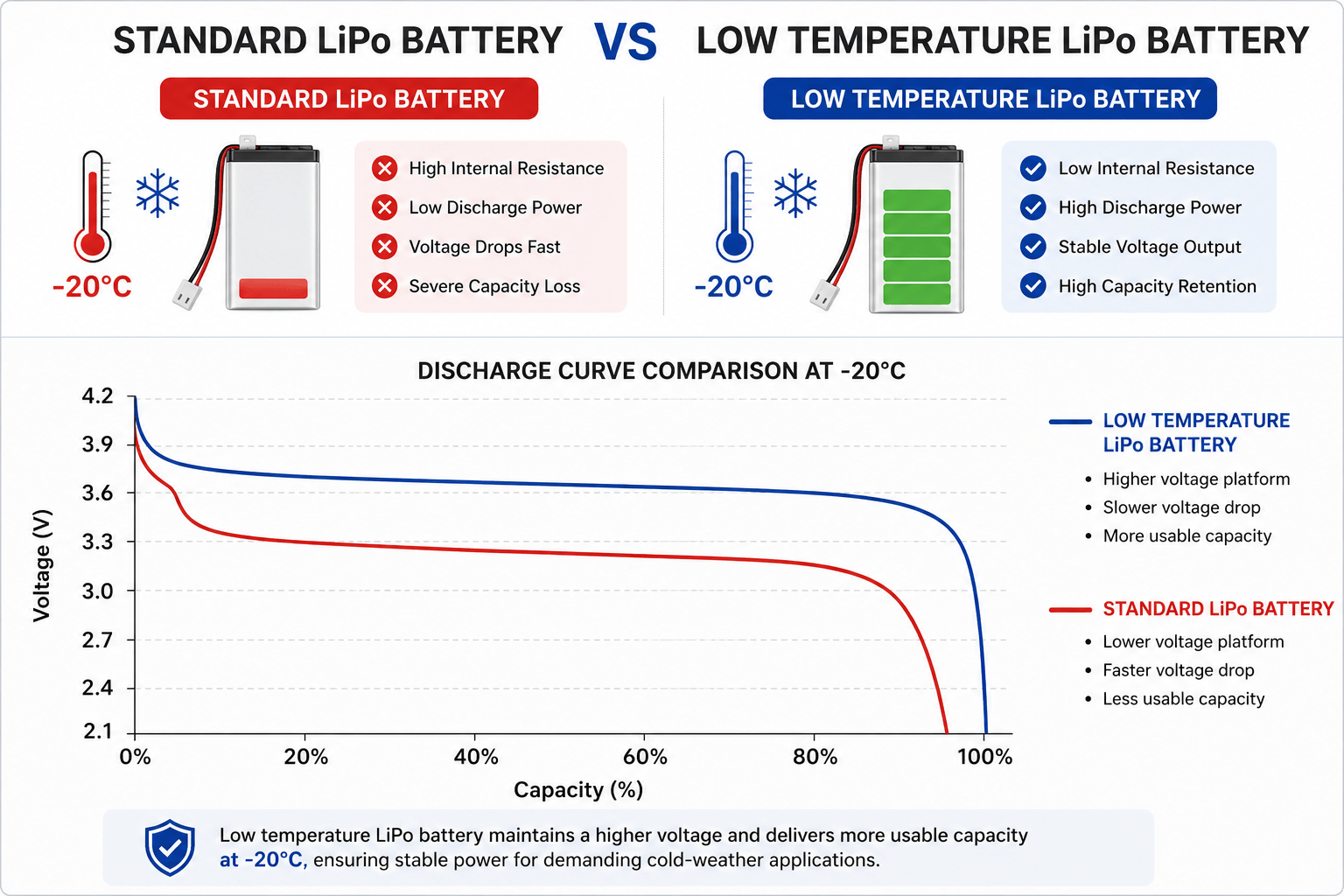
A low temperature LiPo battery is a specially engineered lithium polymer battery designed to maintain reliable discharge performance in cold environments where standard LiPo batteries may experience capacity loss, increased internal resistance, and voltage drop.

ZERNE low temperature LiPo batteries use optimized electrolyte systems, electrode materials, and cell designs to improve ion transport and maintain more stable voltage and usable capacity at sub-zero temperatures. Selected solutions are designed for operation in environments down to -40°C, depending on the cell design and operating conditions.

These batteries are suitable for OEM devices that need reliable power in cold environments, including GPS trackers, IoT monitoring devices, drones, cold-chain equipment, outdoor electronics, and industrial sensors.

Safe Charging

Stable Internal Resistance

Optional Self-Heating

Extreme Cold Resistance

Balanced Longevity

Why Do Standard LiPo Batteries Perform Poorly in Cold Temperatures?

As temperature decreases, the electrochemical activity inside a lithium battery slows down significantly.
This leads to several common issues:

Increased Internal Resistance: Cold temperatures increase the battery's internal resistance, making it harder for current to flow efficiently.
Reduced Discharge Capability: The battery's ability to deliver power decreases, especially under high load conditions.
Voltage Drop Under Load: Devices may shut down unexpectedly because the battery voltage drops rapidly when current is drawn.
Capacity Loss: A significant portion of the battery's stored energy becomes temporarily unavailable at low temperatures.
 
As a result, devices that operate normally at room temperature may experience shorter runtime, reduced performance, or complete failure in cold environments.
 

How Low Temperature LiPo Batteries Overcome These Challenges

ZERNE Low temperature lithium polymer batteries are specifically designed to maintain electrochemical activity even in freezing conditions.
Key technologies include:

Specialized Low-Temperature Electrolytes: Advanced electrolyte formulations improve ion conductivity at low temperatures, allowing lithium ions to move more freely within the cell.
Optimized Anode Materials: Modified graphite and low-temperature electrode materials help improve lithium-ion diffusion and reduce polarization effects.
Enhanced SEI Film Technology: A stable and optimized Solid Electrolyte Interphase (SEI) layer minimizes resistance growth and supports efficient charge transfer in cold conditions.
Low-Resistance Cell Design: The overall cell structure is engineered to reduce internal resistance and maintain stable voltage output under load.


Low-Temperature Performance Benefits

Compared with standard lithium polymer batteries, ZERNE low temperature LiPo batteries provide:
Stable operation down to -40°C
Higher capacity retention in freezing environments
Reduced voltage sag under load
Improved cold-start performance
Longer runtime for outdoor and winter applications
Greater reliability for mission-critical devices

Why Standard LiPo Batteries Fail in Cold Temperatures

As temperatures drop below freezing, the electrochemical reactions inside a standard LiPo battery become less efficient, leading to significant performance loss.
  • Slower Lithium-Ion Movement

    Low temperatures slow the movement of lithium ions between the electrodes, reducing the battery's ability to deliver power efficiently.
  • Reduced Electrolyte Conductivity

    The electrolyte becomes less conductive in cold environments, making it more difficult for lithium ions to travel through the cell.
  • Increased Internal Resistance

    Higher internal resistance causes greater voltage drop under load, resulting in reduced discharge capability and shorter runtime.

Result

This is why standard lithium batteries often struggle below 0°C, while ZERNE low temperature LiPo batteries are specifically engineered to maintain reliable performance in environments as cold as -40°C.

Product Details

Explore available ZERNE low temperature LiPo battery models by capacity and dimensions. Select a model below to view detailed specifications, or contact us for a custom size or capacity.
Model Voltage Capacity
(mAh)
Charge Rate Size Internal resistance
(mΩ)
Thickness(mm) Width(mm) Length(mm)
603040 3.7V  700 1C 6.0 30 40 70
503638 3.7V 740 1C 5.0 36 38 80
603450 3.7V 1000 1C 6.0 34 50 70
524169 3.7V 1900 1C 5.2 41 69 50
684060 3.7V 2200 1C 6.8 40 60 50
714060 3.7V 2200 1C 7.1 40 60 50
804060 3.7V 2500 1C 8.0 40 60 50
734765 3.7V 3000 1C 7.3 47 65 50
754775 3.7V 3000 1C 7.5 47 75 40
965086 3.7V 4850 1C 9.6 50 86 40
115080 3.7V 5000 1C 11 50 80 40
105070 3.7V 5000 1C 10 50 70 40
Need a different size or capacity? ZERNE offers additional low temperature LiPo battery models and custom battery options beyond those listed above. Contact us with your voltage, capacity, dimensions, and operating temperature requirements.

Need a Custom Low Temperature Battery for Your Project?​​​​​​​

If none of the standard models above matches your device, ZERNE can evaluate a custom low temperature LiPo battery based on your available battery space, required capacity, discharge current, operating temperature, connector, and protection requirements. Our engineering team can help match the battery design to your device and cold-environment operating conditions.

What Can Be Customized?

 
Capacity & Cell Dimensions
Match the battery to available device space and runtime requirements.

Connector & Wire
Configure connector type, wire length, polarity, and cable exit requirements.

Protection & Temperature Sensing
PCM/BMS and NTC options can be evaluated according to the device design.

Low-Temperature Performance
Battery design can be evaluated according to the required discharge temperature and load conditions.
 

What We Need From You


Lowest operating temperature

Nominal voltage

Required capacity or runtime

Continuous and peak discharge current

Maximum battery dimensions

Connector and wire requirements

Charging temperature and charging method

Device application
 

Applications of Low Temperature Lithium-Ion Polymer Battery

Low temperature LiPo batteries are suitable for wearable, tracking, and heating devices that need reliable battery performance in freezing or winter environments. ZERNE provides battery solutions for applications ranging from compact smart watches and GPS trackers to heated gloves, hand warmers, and heated clothing.

Certified Quality, Global Trust

Related Articles

June 12, 2026

You might ask if you can charge battery when it is freezing outside. Many people are scared about safety, battery damage, and if charging works in the cold. Most lithium-ion batteries should not be charged below 32°F.

February 11, 2026

You have many problems when you use a lipo battery in very cold weather. It is important for your devices to work well in the cold. This matters for things like airplanes, cars, and even health tools. Many batteries lose power or can be unsafe if you charge them when it is colder than 5°C.
February 10, 2026

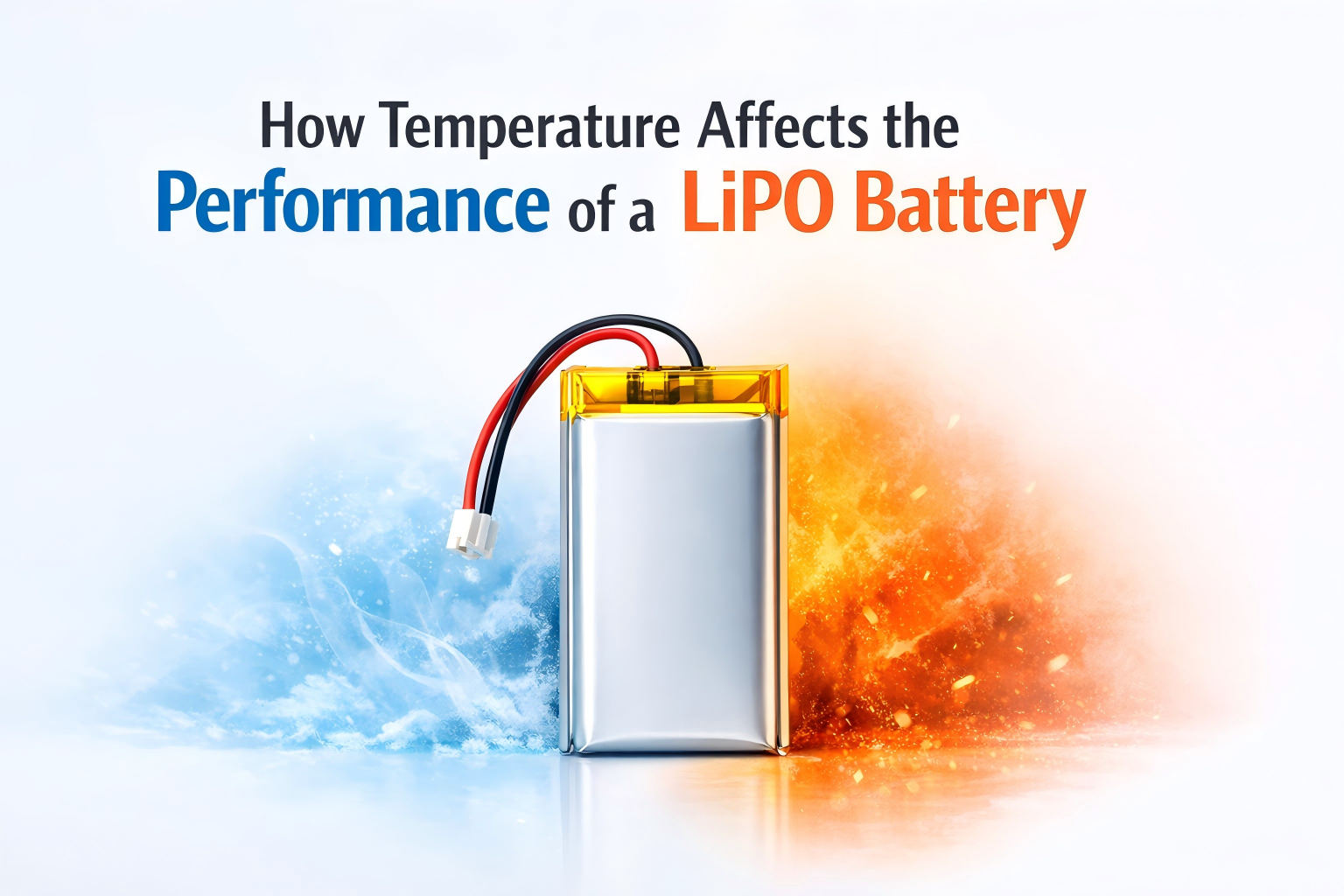
Temperature changes affect your LiPO battery in many ways. When it is very hot or cold, the battery does not last as long. It also cannot hold as much power and will not live as long. High temperatures make the inside parts break down faster. This can make the battery swell or even catch fire.

Contact Us

Let us find the right battery solution for you.

FAQs
  • Can Lithium Polymer Batteries Work at -40°C?
    Created with Sketch.
    形状 Created with Sketch.
    Yes. Standard LiPo batteries typically experience significant performance loss below 0°C. However, specially engineered low temperature LiPo batteries can operate in environments as cold as -40°C by using advanced electrolyte systems and optimized cell materials, ensuring reliable power delivery in extreme cold conditions.
  • What Is the Difference Between a Standard and Low Temperature LiPo Battery?
    Created with Sketch.
    形状 Created with Sketch.
    ZERNE Low temperature lipo batteries use electrolyte, electrode, and cell design optimizations to improve ion transport and reduce performance loss in cold environments. Compared with standard lipo batteries, they are designed to provide more stable voltage, higher usable capacity, and better discharge performance at sub-zero temperatures.
  • Can Low Temperature Batteries Be Charged Below 0°C?
    Created with Sketch.
    形状 Created with Sketch.
    Charging capability depends on the battery design. Standard LiPo batteries are generally not recommended for charging below 0°C. Certain low temperature LiPo batteries can support charging at sub-zero temperatures when specifically designed for cold-weather applications. Please contact our engineering team for detailed charging specifications.
  • How Much Capacity Is Retained at -20°C?
    Created with Sketch.
    形状 Created with Sketch.
    Capacity retention varies by battery design and discharge conditions. A standard LiPo battery may retain only about 40–50% of its usable capacity at -20°C, while a low temperature LiPo battery can typically retain around 70–80% capacity, providing significantly longer runtime and more reliable performance.
  • What Applications Require Low Temperature Batteries?
    Created with Sketch.
    形状 Created with Sketch.
    Low temperature LiPo batteries are widely used in devices operating in cold or extreme environments, including:
    • GPS Tracking Devices
    • Cold Chain Monitoring Systems
    • Drones & UAVs
    • Outdoor Security Cameras
    • Heated Gloves & Heated Apparel
    • IoT Monitoring Devices
    • Industrial Sensors
    • Arctic & High-Altitude Equipment
    These applications require reliable power delivery where standard batteries may experience significant performance degradation.
  • How Do I Choose the Right Low Temperature LiPo Battery for My Device?
    Created with Sketch.
    形状 Created with Sketch.
    Start with the lowest operating temperature, required voltage and capacity, continuous and peak current, available battery dimensions, charging temperature, and connector requirements. These parameters determine whether a standard model is suitable or whether a custom low temperature battery design should be evaluated.
  • Do You Offer Custom Low Temperature Battery Packs?
    Created with Sketch.
    形状 Created with Sketch.
    Yes. ZERNE provide custom low temperature lithium polymer batteries with configurable voltage, capacity, dimensions, connectors, and protection circuits to meet specific application requirements.
  • What Is the Operating Temperature Range of Your Low Temperature LiPo Batteries?
    Created with Sketch.
    形状 Created with Sketch.
    ZERNE low temperature LiPo batteries are available with operating temperature ranges down to -40°C, while maintaining stable discharge performance and improved capacity retention compared with standard lithium polymer batteries.
Guangdong Zhaoneng Technology co.,ltd.
We are a professional manufacturer of new energy lithium batteries integrating R&D, design, manufacturing and sales with 28 years experience.

QUICK LINKS

PRODUCT CATEGORY

CONTACT US

Telephone: +86-757-81289780
Phone: +86-13724662111
E-mail: info@zn-battery.com
WhatsApp: +8613724662111
Add: No.11, DouKou Ave., XiaJiao Vil., Danzao, Nanhai District, Foshan, Guangdong, China. 528216.
Copyright ©  2025 Guangdong Zhaoneng Technology Co.,Ltd. All Rights Reserved. Privacy PolicySitemap