
Views: 0 Author: Site Editor Publish Time: 2026-06-12 Origin: Site
You might ask if you can charge battery when it is freezing outside. Many people are scared about safety, battery damage, and if charging works in the cold. Most lithium-ion batteries should not be charged below 32°F. This is because it can cause lithium plating and make the battery not last as long. If you look at the table below, you will see that each battery type has its own charge and discharge temperature range.
Battery Type | Charge Temp Range | Discharge Temp Range |
|---|---|---|
Lithium-ion | 32°F to 113°F | -4°F to 140°F |
Lead-acid | -4°F to 122°F | -4°F to 122°F |
Nickel-based | 32°F to 113°F | -4°F to 149°F |
Some special batteries and chargers now let you charge battery safely when it is freezing, but you must always do the right steps.
Do not charge lithium-ion batteries if it is below 32°F. Charging when it is cold can hurt the battery forever.
Warm up batteries before you charge them. Bring them inside or use a battery heater to stop problems.
Use slow charging methods when it is cold outside. This lowers the chance of damage and helps the battery charge safely.
Think about using self-heating chargers or batteries with heaters inside for safer charging when it is freezing.
Check the battery’s health and temperature often. This helps stop problems and makes the battery last longer.
You might wonder if it is safe to charge a battery when it is freezing. Most companies say not to charge lithium-ion batteries below 32°F. Charging in the cold can cause lithium plating. This happens when lithium ions pile up on the anode. They do not move inside the battery like they should. This can make the battery lose power forever. It can also make short circuits more likely. Unless you have a battery made for cold, do not charge it when it is freezing.
Lead-acid batteries also have trouble in the cold. Here are some things that can go wrong:
If you charge a frozen lead-acid battery, the case can crack.
A lead-acid battery with no charge can freeze at 20°F.
If you do not use temperature compensation, the battery may not charge right. This can cause sulfation and less power.
Nickel-based batteries, like nickel-metal hydride, do not charge well in the cold. The electrolyte does not work as well. It is harder for the battery to take a charge. Charging takes longer, and the battery may not get full. Over time, this can make the battery not last as long.
Tip: If you need to charge a battery in the cold, warm it up first. Bring it inside or use a battery heater. Always use a charger that matches your battery’s voltage and chemistry. Keep the charging current low near freezing to keep the battery safe.
When it gets cold, the battery’s chemistry changes. The electrolyte gets thick and moves slower. This makes it harder for ions to move. The chemical reactions slow down. The SEI film inside the battery gets thicker. This makes it even harder for ions to move.
Here is what happens inside a lithium-ion battery when it is cold:
The electrolyte does not conduct as well, and it gets thicker.
The SEI film gets thicker and adds resistance.
Lithium ions move slower, especially when charging.
The battery can get lithium plating, which can hurt it.
You can see how cold changes battery performance in the chart below. When it is cold, the battery’s resistance goes up. This means your devices may lose power faster. Charging does not work as well.
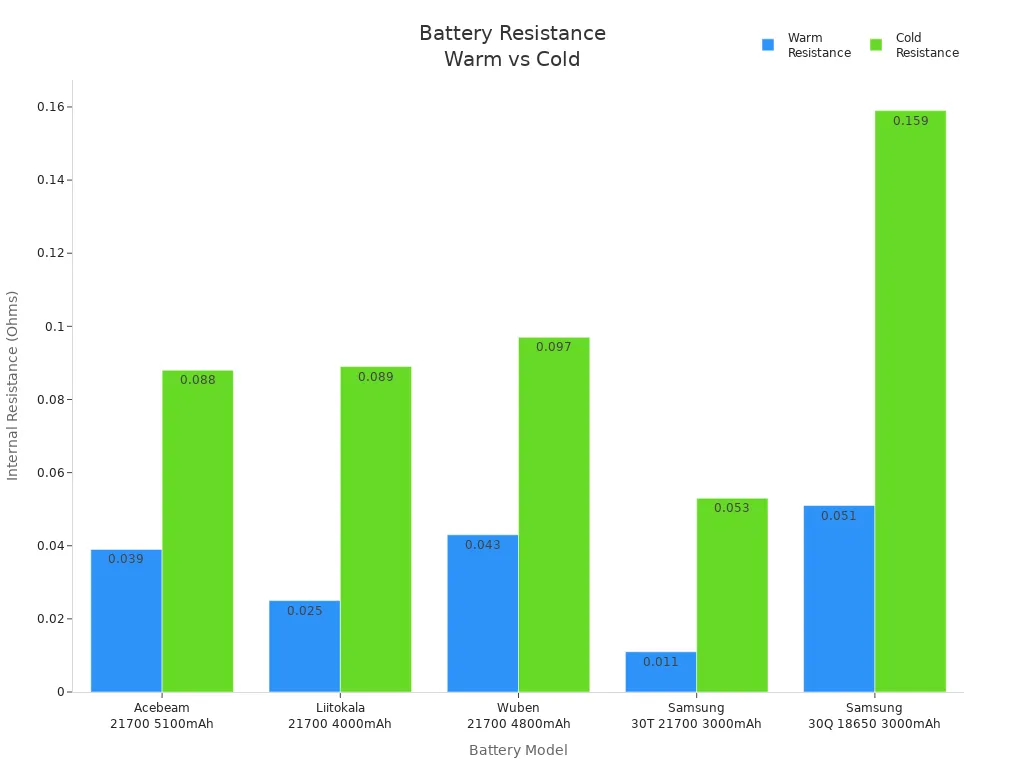
Battery Model | Warm Resistance (Ohms) | Cold Resistance (Ohms) |
|---|---|---|
Acebeam 21700 5100mAh | 0.039 | 0.088 |
Liitokala 21700 4000mAh | 0.025 | 0.089 |
Wuben 21700 4800mAh | 0.043 | 0.097 |
Samsung 30T 21700 3000mAh | 0.011 | 0.053 |
Samsung 30Q 18650 3000mAh | 0.051 | 0.159 |
The table shows that cold batteries have higher resistance. This means your devices may stop working sooner. Charging is also harder.
Note: Charging in the cold can damage the battery forever. For example, charging a lithium-ion battery at -10°C above 0.25C can make it lose up to 25% of its power after 40 charges. Even at 0°C, charging at 1C can make it lose 3.6% of its power.
Companies test battery safety and performance in the cold by using temperature cycling tests. These tests help find weak spots and make sure the battery is safe.
You may notice your battery does not work well in cold weather. When you use a battery in winter, the cold slows down the chemical reactions inside. The particles in the battery move slower, so the battery cannot give as much power. The electrolyte inside the battery gets thick and does not let ions move easily. This means your battery loses power faster and may not charge well.
The conductivity of the electrolyte drops in cold weather, so the battery voltage goes down.
Chemical reactions slow down, so you get less power and less charge.
The ions in the battery move slower, which makes it harder for the battery to work.
You may see your device shut off early or show a dead battery, even if you charged it before.
If you keep your battery in a low temperature environment for a long time, it can lose 20-30% of its power. The battery may not last as long as it should. Repeated use in cold weather can cause permanent damage. You may see your battery fail sooner than expected.
Tip: Always try to keep your battery warm in winter. Store it inside when you can. If you must use it in a low temperature environment, check it often.
Charging a battery in cold weather can be risky. If you try to charge a battery in a low temperature environment, you may cause lithium plating. This happens when lithium ions stick to the anode instead of going inside. The battery can get damaged forever. You may see a dead battery or even a short circuit.
Lithium plating can happen below 32°F, which can ruin your battery.
The battery may lose power quickly or not hold a charge.
The risk of internal short circuits goes up, which can be dangerous.
If you charge too fast in cold weather, the battery can get even more damage. Slow charging is safer because it gives the ions more time to move. Fast charging in winter can freeze the electrolyte and cause battery failure. You should always use a charger made for cold weather if you need to charge in winter.
Note: Repeated charging in cold weather can cause lithium dendrites to form. These can poke through the battery and cause it to fail. Always follow safe charging steps in winter to protect your battery.
Charging a battery when it is freezing can be hard. You need to use the right way to keep your battery safe. Here are three ways to charge your battery in cold weather.
A special charger can help in cold weather. This charger warms up the battery before charging starts. The charger heats the battery until it is above freezing. Then, it begins to charge the battery. You may have to wait 1 to 3 hours for the battery to get warm.
Pros of Self-Heating Methods | Cons of Self-Heating Methods |
|---|---|
Enhances safety in cold environments | May increase energy consumption |
Protects against human error | Installation may be complex |
Extends battery lifespan in freezing temperatures | Potentially higher initial costs |
Steps for Using a Self-Heating Charger:
Connect the battery to the special charger.
Wait for the charger to heat the battery above freezing.
Start charging when the battery is warm.
Watch the battery while it charges.
Tip: Always use a charger made for low temperature rechargeable batteries. This method keeps your battery safe and helps battery life stay strong.
Some batteries have a Battery Management System (BMS) or Protection Circuit Module (PCM). These systems protect your battery in cold weather. The BMS can warn you if the battery is too cold. It can also use self-heating to warm the battery before charging.
Functionality | Description |
|---|---|
Self-Heating | Uses reserved power to heat the battery before charging in low temperatures. |
Advantages | Short waiting time and customizable reserved power based on ambient temperature. |
Disadvantages | Reduced operating capacity due to reserved power for heating. |
How to Use BMS/PCM Self-Heating:
Make sure your battery has BMS or PCM.
Check the settings for low temperature protection.
Let the BMS use reserved power to heat the battery.
Start charging when the battery is warm enough.
Note: This method gives you a shorter wait time. You can change the reserved power based on how cold it is outside. This helps keep battery life strong and keeps your battery safe.
If you do not have a special charger or BMS, you can use slow charging. Slow charging helps the battery warm up slowly and lowers the risk of damage. You must use the right charging current for your battery type.
Battery Type | Recommended Charging Current |
|---|---|
Lithium-ion | No charge permitted below freezing |
Nickel-based | Reduce to 0.1C when below freezing |
Lead-acid | Charge at 0.3C at low temperatures |
Steps for Slow Charging:
Check the battery type and recommended charging current.
Set the charger to a low current (0.1C for nickel-based, 0.3C for lead-acid).
Watch the battery while it charges.
Stop charging if the battery gets too cold or shows warning signs.
Alert: Never charge lithium-ion batteries below freezing. This can cause lithium plating and damage the battery forever.
Recent Advances in Cold Weather Charging:
Tesla and other electric vehicles warm the battery before charging.
New aluminum-anode batteries work well in cold and keep more than 85% capacity at -34°C.
Researchers have made liquid-solid batteries that work in extreme cold.
Some chargers now warm the charging port automatically to make charging easier in winter.
Callout: Always follow safe charging steps. Use a method that matches your battery and charger. Protect your battery and keep battery life strong in cold weather.
Charging a battery when it is cold can be hard. You need to follow some easy steps to keep your battery safe. Here are some dos and don’ts:
Warm the battery up before you charge it. Charging a cold battery can hurt it.
Use chargers with temperature sensors or protection circuits. These help stop problems when charging in cold places.
Charge inside if you can. This keeps the battery away from cold outside air.
Never charge a battery below 32°F. Charging at low temperatures can cause lithium plating and damage.
Do not leave the battery in your car with a charger overnight. Cold can hurt the battery if you leave it alone.
Do not force-charge a battery that will not charge when cold. Wait until the battery gets warm.
Use a battery charger or maintainer to keep the battery charged, especially if your car sits for a long time.
Protect the battery from cold with a battery blanket or insulator. This helps keep heat in and stops the battery from getting too cold.
Park in a garage or covered spot to keep the battery safe from cold.
Test the battery’s health often to find problems early.
Tip: Always check the battery’s temperature before charging. If it feels cold, let it warm up first.
You might wonder how car battery care is different from other batteries in cold weather. Car batteries have special problems in winter. The fluid inside can freeze if the charge is low, which can break the cells. Cold slows the chemical reaction inside, so the car battery gives less power. This makes it harder to start your car, especially if the cold cranking amps are not high enough.
To keep your car battery healthy in cold, you should:
Drive your car often, at least 30 minutes each week, to keep the car battery charged.
Use a battery maintainer if you take short trips or leave your car parked for a long time.
Park in warm, safe places to keep the battery away from cold.
Pick the best car battery for cold weather, which has higher cold cranking amps and works better in cold.
Change the car battery if it is older than three to five years to stop failures in cold.
Test the car battery’s health before winter to make sure it can handle cold.
For other batteries, like those in electronics, store them between 50°F and 68°F. Use insulated cases to keep the temperature steady. Keep the charge level between 50% and 80% when storing. Always let the battery warm up before charging. Smart chargers that change charging rates based on temperature work best in cold.
Note: Good care and smart charging help all batteries last longer, even in cold weather.
Charging batteries when it is freezing can be dangerous if you do not follow the right steps. Always check how cold the battery is before you try to charge it. Here are some important safety tips:
Do not charge a lithium battery if it is colder than 32°F (0°C).
Take cold batteries inside and let them get warm on their own.
Use a smart charger so you do not overcharge the battery.
Keep batteries in a garage or wrap them with an insulated blanket.
Use a multimeter to check the battery voltage often.
Remember: Let batteries get warm slowly and use pre-heat features if your battery has them. Always think about safety first when charging batteries in cold weather.
You can charge a battery in your car if you use a charger with temperature sensors. Always check the battery temperature first. If the battery feels cold, let it warm up before charging. Charging a cold battery in your car can cause damage.
If you charge your car battery below freezing, you risk lithium plating. This can make your car battery lose power and fail. Always warm up your car battery before charging. Use a charger made for your car and follow safety steps.
You can keep your car battery safe by parking your car in a garage. Use a battery blanket or insulator. Drive your car often to keep the battery charged. Test your car battery health before winter. Always use a charger that matches your car battery.
Your car battery loses power in cold weather because the chemical reactions slow down. The electrolyte gets thick. Your car may not start easily. Always check your car battery voltage. Keep your car battery warm to help it work better.
The best way to charge your car battery in freezing temperatures is to use a charger with self-heating. Warm up your car battery first. Use slow charging if your car battery is cold. Always follow the instructions for your car battery charger.