
Views: 0 Author: Site Editor Publish Time: 2026-03-13 Origin: Site
A drone ESC, or electronic speed controller, is the part that controls how electrical power moves from the battery to the motor. It helps the motor respond to flight controller commands quickly and accurately, which is why it is one of the most important parts of the drone power system.
Without a working ESC, the motors cannot respond correctly, and the drone cannot fly in a stable or controlled way. That is why ESC selection matters for performance, safety, and reliability.
Because ESCs work directly with the motor system, it also helps to read An In-Depth Guide to Drone Motors.
A drone ESC helps control how fast and which way the motor spins. This makes the drone fly smoothly and stay steady.
Picking the right ESC type, brushed or brushless, changes how well your drone works and saves power.
Checking and setting up your ESC often can stop problems and keep flying safe.
Knowing about ESC features like heat protection and how it talks to other parts helps you pick the best one for your drone.
The right ESC makes the drone react faster and stay steady, so flying is more fun.
You can think of a drone ESC as the brain for each motor on your drone. This small device helps you control how fast and in which direction each motor spins. When you send a command from your controller, the ESC listens and makes sure the motors respond quickly and smoothly.
Here is a table that explains the main aspects of an electronic speed controller and how it works in drones:
Aspect | DESCription |
|---|---|
Definition | An Electronic Speed Controller (ESC) regulates power sent from the battery to each motor. |
Function | It translates signals from the flight controller into motor action, enabling maneuverability. |
Power Conversion | Converts DC battery power into three-phase AC required for brushless motors. |
Control Method | Uses pulse width modulation (PWM) to adjust motor speeds, ensuring stable flight operations. |
The ESC sits between the battery, the flight controller, and the motors. It takes the power from the battery and changes it into the type of electricity the motors need. The ESC also listens to the flight controller and makes the motors spin faster or slower, depending on what you want your drone to do.
You need precise control over your drone to fly safely and perform tricks. The ESC gives you this control by adjusting the speed and direction of each motor. Here is how the ESC helps you fly your drone:
The ESC changes the speed of each motor to help your drone move up, down, or sideways.
It lets you turn or spin your drone by making some motors go faster and others slower.
The ESC can even help you stop the motors quickly, which is important for safe landings.
The ESC works by sending timed electric signals to the motors. It uses pulse width modulation, which means it sends short or long bursts of power to change how fast the motors spin. When you move the throttle stick, the ESC changes the amount of power sent to each motor. This helps you control your drone with accuracy.
Tip: If you want your drone to fly smoothly and respond quickly, you need a good ESC that matches your motors and battery.
A drone ESC does more than just turn the motors on and off. It acts as a smart regulator, making sure your drone stays balanced and stable in the air. When you understand how the ESC works, you can make better choices when building or upgrading your drone.
When you fly your drone, the ESC controls power from the battery to the motors. The ESC works like a smart traffic cop. It chooses how much power each motor gets and when to send it. This helps your drone fly steady and follow your commands.
The ESC uses a few main parts to do its job:
Microcontroller (MCU): This part reads signals and keeps things working right.
Gate Driver: It makes signals stronger so the ESC can switch power fast.
MOSFETs: These work like switches, turning power on and off for the motors.
The ESC does more than just change speed. It also helps with:
Keeping speed steady for smooth flight.
Braking to stop quickly.
Changing direction for sharp turns.
Watching the battery to keep your drone safe.
Controlling heat so nothing gets too hot.
The electronic speed controller takes DC power from the battery and changes it to three-phase AC for brushless motors. It switches the power direction using feedback from the motor's spin. This lets you control how fast and which way your drone moves.
Because MOSFETs are one of the key switching components inside ESCs, you may also want to read What Is a Mosfet in Drone Batteries.
The ESC and flight controller work together as a team. The flight controller tells the ESC how fast each motor should spin. The ESC listens and makes the motors change speed right away.
There are a few ways ESCs and flight controllers talk:
PWM
OneShot
DShot
Multishot
Each way has its own speed and accuracy. For example, DShot sends data faster and with fewer mistakes than PWM. This means your drone can react quicker to your commands.
Some drones use ESCs with telemetry systems. This setup puts the flight controller and ESCs in one unit. You get fewer wires, easier fixes, and faster problem solving. Here is a table that shows how this helps:
DESCription | Benefit |
|---|---|
Combines flight controller and ESCs | Less wiring, better reliability |
Easier maintenance | Faster repairs and less downtime |
Fewer connections | Easier to find and fix problems |
When you know how the ESC and flight controller work together, you can make better choices for your drone's safety and performance.
When you choose an ESC for your drone, you need to know the difference between brushed and brushless types. Brushed ESCs work with brushed motors, while brushless ESCs control brushless motors. Each type has its own strengths and best uses.
Here is a table to help you compare them:
Type | Efficiency | Power Output | Lifespan | Best Application |
|---|---|---|---|---|
Brushed ESC | Medium | Limited | Shorter | Entry-level RC models, toys |
Brushless ESC | High | High | Longer | Drones, high-speed RC aircraft |
Brushed ESCs have a simple design and cost less. You might use them for beginner drones or toys. They need more maintenance and do not last as long.
Brushless ESCs give you high efficiency and power. You get better speed and longer life. These work best for drones and fast RC planes.
Note: Most modern drones use brushless ESCs because they match well with a brushless drone motor for better performance.
A 4-in-1 ESC puts four controllers on one board. This design makes your drone lighter and easier to build. You save time on wiring and soldering. The board sits in the center, which helps balance and makes your drone respond faster.
Feature | 4-in-1 ESCs | Individual ESCs |
|---|---|---|
Weight Distribution | Centralizes ESCs, better balance | More wiring, adds weight |
Installation | Quick, fewer solder joints | More time needed, more wiring |
Cooling | Less direct airflow, may get warmer | Mounted on arms, better cooling |
Replacement | Replace whole board if one fails | Replace only the failed ESC |
You can use one 4-in-1 ESC or four separate ESCs for each drone motor. Each setup has pros and cons.
Feature | Single ESC (4-in-1) | Multi-ESC (Separate) |
|---|---|---|
Installation | Quick, no extra soldering | More complex, needs more wiring |
Cost | Usually cheaper | Often more expensive |
Failure Impact | Replace whole unit if one fails | Replace only the broken ESC |
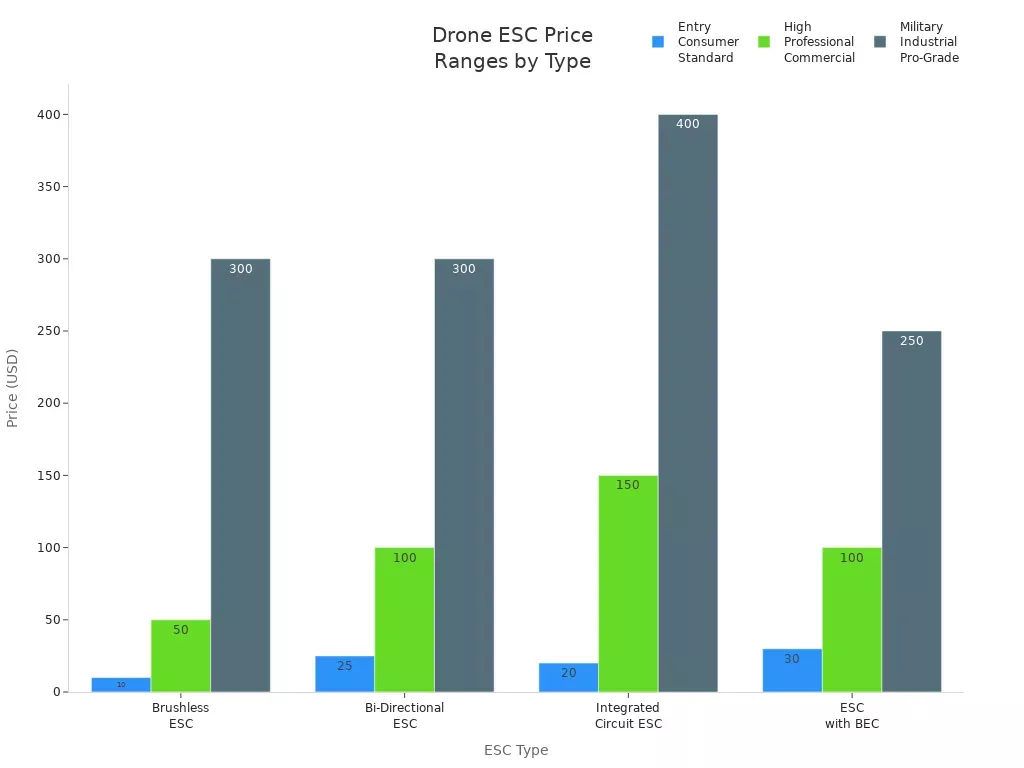
Tip: If you want easy repairs, choose separate ESCs. If you want a lighter and cleaner build, try a 4-in-1 ESC.
The ESC helps keep your drone steady in the air. It connects the flight controller to each motor. When you move the controls, the ESC changes motor speed and direction fast. This quick change helps your drone stay balanced. Even if the wind blows or you turn sharply, the ESC helps keep control.
Good ESCs work with special firmware like BLHeli_S and DShot. These let the ESC send signals faster and give better control.
The ESC balances the motors while you fly. If it is not precise, your drone might wobble or lose balance, especially in hard conditions.
If the ESC is slow, your drone can shake or even stop. This makes flying harder and less fun.
Note: Pick and care for your ESC to keep your drone safe. Always check your ESC before flying.
The ESC decides how much power each motor gets. This affects how fast your drone flies and how quickly it turns. It also affects how much weight your drone can lift. A good ESC gives you more speed and stronger torque. Your drone can take off faster and do harder tricks.
The ESC's firmware lets it talk to the flight controller quickly. This gives you better control and makes your drone more agile.
New ESCs have safety features like low-voltage cutoff and thermal protection. These help keep your drone safe during fast moves.
The ESC changes voltage and current for the motors. This keeps your drone running well and helps the battery last longer.
ESC Feature | Importance in Drones | Performance Impact |
|---|---|---|
Switching Frequency | High | Makes motors respond faster and reduces shaking for smoother flight. |
Weight | High | Lighter ESCs help your drone fly longer and use less battery. |
Thermal Management | Medium | Good cooling stops overheating and keeps your drone working well. |
Tip: For a fast and long flight, pick an ESC with smart firmware and good cooling.
Your ESC can have problems if you do not care for it. Heat, dust, heavy loads, and long flights can make it work worse. If the ESC gets too hot, its parts can break. This can make a motor lose power suddenly.
If an ESC breaks, your drone might fall or lose control. The flight controller cannot fix a stopped motor.
Water and humidity can hurt the ESC. Water can cause rust or short circuits, which may stop your drone in the air.
Moving your drone from hot to cold places can cause water drops inside the ESC. This can damage the parts and make your drone not last as long.
Alert: Always look for heat damage or rust on your ESC. Keep your drone dry and store it safely to avoid water problems.
You can stop most ESC problems by doing simple things:
Let your drone cool down after flying.
Clean dust and dirt from the ESC and motors.
Do not fly in rain or when it is very humid.
Let your drone get used to new temperatures before flying.
A clean and cared-for ESC keeps your drone safe and working well. You get steadier flights, longer battery life, and more fun every time you fly.
To pick an ESC for your drone, look at its main features. The best ESC depends on how you fly your drone. Racing drones need quick throttle and good heat control. Photography drones need smooth motors and steady flying. Use this table to see what is important:
Specification | Racing Drones | Photography Drones |
|---|---|---|
Throttle Response | Rapid throttle response required | Smooth motor control prioritized |
Communication Protocols | High-frequency protocols (DShot1200) | Sine-wave or bidirectional DShot |
Build Quality | Compact, robust firmware | Stable for gimbals |
Heat Dissipation | Handles aggressive flying | Lower heat generation preferred |
If your drone needs stronger bursts of current and more aggressive response, ZERNE's high discharge rate battery solutions are also worth reviewing when planning the full power system.
You should also look for safety features. These help protect your ESC and drone motor. Check for overcurrent, low-voltage cutoff, and thermal shutdown.
Protection Type | Function | Importance for Drone Operations |
|---|---|---|
Overcurrent | Prevents motor and ESC damage | Critical |
Low-voltage cutoff | Prevents battery over-discharge | Important |
Thermal shutdown | Protects ESC from heat damage | Very Important |
You need to calibrate your ESC for the best results. Follow these steps to keep your drone motor working well:
Take off the propellers to stay safe.
Turn on your transmitter and push the throttle up.
Connect the battery and listen for beeps from the ESC.
Pull the throttle down after the first beeps.
Wait for more beeps to finish calibration.
Tip: Calibrate again if you change your ESC or flight controller settings.
To stop problems, pick an ESC that matches your drone and flight controller. If you use the wrong ESC, your drone may not work well or could break. Always check voltage and firmware before using a new ESC.
Some common problems are overheating, calibration mistakes, and signal problems. You can stop these by:
Picking the right ESC rating for your drone motor.
Keeping wires tidy to stop signal problems.
Updating firmware for better flying.
Checking for damage after each flight.
Note: Check and clean your ESC often. This helps it last longer and keeps your drone safe.
A drone ESC is important because it directly controls how the motors respond, how stable the aircraft feels, and how safely the drone handles power. It is one of the core parts of the flight system, not just a secondary accessory.
If you choose the right ESC and match it correctly to the motor and battery, your drone will usually feel smoother, safer, and more predictable in flight.
If you need help matching ESC requirements to a drone motor and battery setup, contact us for technical support.
If your ESC fails, your drone may lose power to one or more motors. This can cause your drone to crash or fall. Always check your ESC before flying to stay safe.
You cannot use just any ESC with any motor. You must match the ESC's current rating and voltage to your motor and battery. Using the wrong ESC can damage your drone.
You may notice:
Hot ESC casing
Sudden loss of power
Strange smells or smoke
If you see these signs, land your drone and let it cool.
You do not need to calibrate your ESC every flight. Calibrate when you install a new ESC, change settings, or notice motor issues. Regular calibration keeps your drone flying smoothly.