
Views: 0 Author: Site Editor Publish Time: 2026-03-12 Origin: Site
A drone motor is one of the most important parts of the aircraft. It spins the propellers, creates lift, and controls how the drone climbs, turns, hovers, and responds in flight. If the motors do not work properly, the drone cannot fly safely or efficiently.
Understanding drone motors helps you choose the right setup for speed, stability, payload, and flight time. It also helps you avoid common mistakes when matching motors, propellers, batteries, and ESCs.
Because motors work closely with the electronic speed controller, it also helps to understand What is a Drone ESC and Is it Important.
Learn how brushed and brushless motors are not the same. Brushless motors work better and last longer. This makes them best for most drones.
Pick a motor that fits what your drone will do. Racing drones need high KV motors to go fast. Photography drones need motors with more torque to stay steady.
Always look at the thrust-to-weight ratio. You need at least a 2:1 ratio for safe flying. This helps your drone fly well.
Take care of your motors often. Clean them after every flight. Check their temperature so they do not get too hot. This helps them last longer.
Use the right propeller size with your motor. The right match makes your drone work better. It also gives you more control when flying.
Drone motors turn electrical energy into mechanical motion. That motion spins the propellers and creates the lift and thrust needed to move the drone through the air.
| Motor Role | What It Does |
|---|---|
| Lift and Propulsion | Makes the drone rise, hover, climb, and move in different directions. |
| Control Response | Changes speed quickly so the drone can turn, brake, and stabilize. |
| Flight Stability | Works with the flight controller and ESC to keep the aircraft balanced. |
If you are still deciding what kind of FPV platform you want to build, read our blog: What Size FPV Drone Should I Get.
When you look at drones, you will see many types of motors. Each type has its own strengths and best uses. This part of the In-Depth Guide will help you understand the main types and how they fit different drone needs.
You will often hear about brushed and brushless motors. These are the two main types you will find in drones.
Brushed motors use brushes to make the motor spin. They are simple and cost less. You may see them in toy drones or small indoor models.
Brushless motors do not use brushes. They use magnets and electronic parts to spin. Most modern drones use brushless motors.
Tip: Brushless motors last longer and work better than brushed motors. You will spend less time fixing them.
Here is a table that shows why brushless motors are more popular:
Advantage | Description |
|---|---|
Efficiency | Converts electrical energy to mechanical energy more effectively, reducing energy loss. |
Longevity | Lasts longer because there are no brushes to wear out. |
Reduced Maintenance | Needs less upkeep, saving you time and money. |
You will find that brushless motors are more efficient. They waste less energy as heat. They also last longer because there are no brushes to wear down. You will not need to replace them as often, which saves you money and time.
Coreless motors are a special kind of brushed motor. They do not have a heavy iron core. This makes them lighter and faster to start and stop. You will see coreless motors in very small or lightweight drones.
You can use coreless motors when you want a drone that is light and quick.
They are good for micro drones and indoor flying.
They do not last as long as brushless motors, but they cost less.
You will also hear about outrunner and inrunner motors. These terms tell you how the motor spins.
Outrunner motors have the outer shell spinning around the inside. They give more torque, which means they can turn bigger propellers. You will see these in most camera drones and heavy-lift drones.
Inrunner motors have the inside spinning while the outer shell stays still. They spin faster but give less torque. You will find these in racing drones and some lightweight models.
Here is a table to help you match motor types to drone uses:
Application Type | Motor Type | Characteristics |
|---|---|---|
FPV Racing | Inrunner Motors | High-speed, lightweight, ideal for agility and acceleration. |
Aerial Photography | Outrunner Motors | Higher torque, stability, suitable for heavier drones requiring longer flight times. |
Lightweight Drones | Inrunner Motors | Efficient for speed, but may lack torque compared to outrunner motors. |
You can see that different motors fit different jobs. If you want to race, you need speed and quick moves. Inrunner motors work best for this. If you want smooth video or to carry a camera, you need power and steady flight. Outrunner motors are the right choice.
You can also look at how motor specs change for each drone type:
Application | Power Range | Typical RPM | Key Feature Priorities |
|---|---|---|---|
FPV Racing Drones | 300–600W | 25,000–50,000 | High speed, lightweight, rapid response |
Photography Drones | 200–400W | 8,000–15,000 | Smooth operation, low vibration, quiet running |
Industrial Inspection | 400–800W | 10,000–20,000 | Durability, heat dissipation, environmental sealing |
Heavy-Lift & Cargo Drones | 800W–1.5kW | 6,000–12,000 | High torque, structural strength, efficiency |
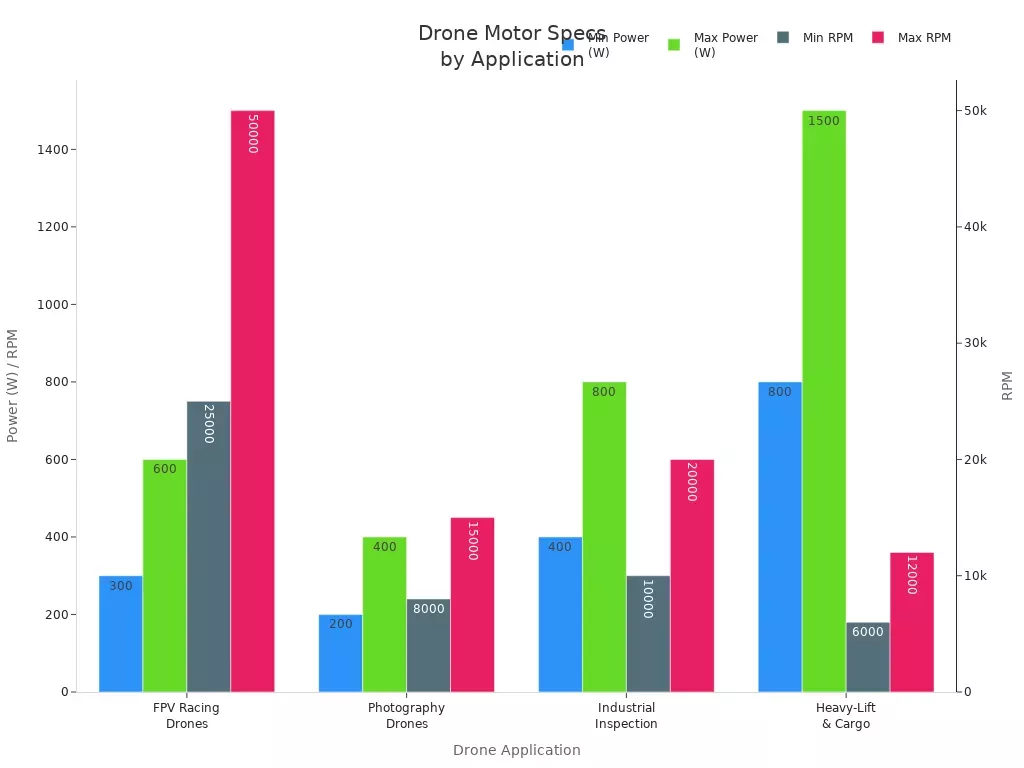
Note: New motor designs keep getting better. Makers now use lighter materials and smarter shapes. This helps drones fly longer and use less battery. You will see more brushless motors and new setups in the latest drones.
When you choose a motor, think about what you want your drone to do. The right motor will help your drone fly better, last longer, and fit your needs.
You control a drone by sending signals to its motors. Brushless DC motors work with electronic speed controllers, called ESCs. These motors and ESCs help your drone fly safely and well. The ESC is like a smart bridge. It changes your commands into power and speed for the motors. This setup lets you control your drone exactly how you want. It also makes the drone work well every time. You can turn on the ESC before you use the throttle. You should wait a little between changes to stop signal noise. Always check the ESC and motor temperature on long flights. Keep an emergency stop command ready in your code.
A drone motor does not work alone. It operates together with the ESC, flight controller, battery, and propeller. The flight controller sends commands, the ESC converts those commands into controlled power, and the motor turns that power into propeller motion.
| Component | Role |
|---|---|
| Motor | Converts electrical power into rotational force. |
| ESC | Controls motor speed and response. |
| Battery | Provides the electrical energy for the system. |
| Flight Controller | Coordinates motor behavior to keep the drone stable. |
| Propeller | Turns rotation into lift and thrust. |
If you want to compare battery direction for different motor and flight styles, ZERNE’s FPV drone battery is a practical next step.
You need to know about motor specs to make good choices. Three main things matter: KV rating, thrust, and torque.
Parameter | Description |
|---|---|
KV Rating | Shows how many times the motor spins per volt. Higher KV means faster spins but less torque. |
Thrust | The force that lifts the drone. It must be more than the drone’s weight for safe flying. |
Torque | The turning force. High torque is good for big propellers. Low torque is fine for small, fast propellers. |
High KV motors are best for racing drones. They spin fast but have less torque.
Low KV motors are good for heavy drones. They give more torque for bigger propellers.
Your drone needs a thrust-to-weight ratio of at least 2:1 to fly well.
You need to match your motor to your drone type. This step helps your drone fly safely and efficiently. Each drone has unique needs. Racing drones need speed. Photography drones need stability. Heavy-lift drones need power. You must check several factors before you choose a motor.
Here is a table that shows what you should look for:
Factor | Description |
|---|---|
Battery Compatibility | Make sure the motor's voltage range matches your battery. This affects RPM and power output. |
Efficiency and Motor Data | Pick high-efficiency motors for longer flight times. Efficient motors convert more energy. |
Motor Mounting | Check if the motor fits your drone's frame and mounting holes. |
Cooling and Heat Dissipation | Motors must get rid of heat well. This prevents failure and helps motors last longer. |
Thrust-to-Weight Ratio | Aim for a 2:1 ratio for most drones. Racing drones may need up to 5:1 for best performance. |
Application-Specific Considerations | Choose motors based on your drone's job. Racing, photography, or cargo drones need different features. |
Tip: Always check the thrust-to-weight ratio. If your drone weighs 1 kg, your motors should provide at least 2 kg of thrust.
You can use this to compare motor specs for your drone's purpose. If you want to carry a camera, you need motors with more torque. If you want to race, you need motors with higher KV ratings.
Motor power and efficiency change how long your drone can fly and how much it can carry. Efficient motors use less energy and produce less heat. This means your drone can stay in the air longer and carry more weight.
Here is a table that explains how power and efficiency affect your drone:
Metric | Value/Impact |
|---|---|
Efficiency | 85–92% under optimal load |
Operational Time Extension | Efficient motors can give you up to 15–20% longer flight times. |
Thrust-to-Weight Ratio | You need 2–3 times the total weight of your drone for stability. |
Heat Generation | Less heat means your motors last longer and work more reliably. |
You should look for motors with high efficiency ratings. These motors help you save battery power. They also keep your drone cool. If you want longer flights, choose motors that convert more electrical energy into movement.
Note: Efficient motors help you fly farther and carry heavier payloads. They also reduce the risk of overheating.
Motor weight and size play a big role in drone performance and maneuverability. The size of the motor decides how much torque it can make. Torque helps drive bigger propellers and gives your drone lift. If your drone is heavy, you need larger motors and propellers. These motors must have higher torque for stable flight.
You must also consider the KV rating. High KV motors spin faster but have less torque. Low KV motors spin slower but provide more torque. This affects how your drone moves and responds.
Small motors work well for lightweight drones. They help your drone move quickly and turn fast.
Large motors are best for heavy drones. They give more power and keep your drone steady.
Callout: Always balance motor size with drone weight. If your motors are too heavy, your drone will use more battery and fly for less time.
You will see the KV rating listed on every drone motor. This number tells you how fast the motor spins for each volt you give it. For example, a 1000KV motor spins at 1000 revolutions per minute (RPM) for every volt. If you use an 11.1V battery, the motor can spin up to 11,100 RPM. A higher KV rating gives you more speed but less torque. A lower KV rating gives you more torque but less speed. You must choose the right KV rating for your drone’s job. Racing drones use high KV motors for quick speed. Heavy-lift drones use low KV motors for strong lifting power.
Tip: The formula is simple: Motor Speed (RPM) = KV × Voltage (V). Use this to predict how your motor will perform.
Thrust is the force that lifts your drone. Voltage comes from your battery and powers the motor. Both work together to decide how much weight your drone can carry and how fast it can climb. If you use a 1000KV motor with a 3S battery (11.1V) and a 10-inch propeller, you can expect between 500 and 800 grams of thrust. Bigger propellers and higher voltage batteries can give you more thrust. You must match your motor, propeller, and battery for safe and strong flight.
A 1000KV motor with a 3S battery and 10-inch propeller gives 500–800g thrust.
Larger propellers or higher voltage batteries increase thrust.
Enough thrust keeps your drone safe and easy to control.
You must pick the right propeller for your motor. The size and shape of the propeller change how your drone flies. Long or wide propellers need more torque. High KV motors work best with small, light propellers. Low KV motors can spin bigger propellers for more lift. If you want fast turns and quick moves, use small propellers. If you want to carry a camera or fly steady, use bigger propellers with low KV motors.
Motor Type | Best Propeller Size | Flight Style |
|---|---|---|
High KV (e.g., 2300KV) | Small (4–5 inch) | Racing, quick turns |
Low KV (e.g., 900KV) | Large (9–12 inch) | Lifting, smooth flight |
Note: The right motor and propeller match gives you better speed, control, and flight time. Always test your setup before flying high or carrying heavy loads.
You can see that your motor choice changes how your drone moves, turns, and flies. High-torque motors help with sharp moves. High KV motors give you speed. The right balance lets you fly longer and safer.
If you want a broader explanation of voltage, capacity, storage, and battery matching before choosing motors, read our blog: The Ultimate Guide to FPV Battery.
You might face problems with drone motors while flying. Spotting these problems early keeps your drone safe and saves money.
Using propellers that are too big puts stress on the motor. This makes the motor get hot and can cause damage.
Bad ESC calibration leads to electrical problems. Motors can get stressed and stop working.
Flying at high throttle for a long time causes thermal stress. This can ruin rotors and damage insulation.
Vibration wears out motor bearings and shafts faster. Too much vibration makes motors last less time.
Dust and dirt can get inside motors. This causes friction and makes motors less efficient and hotter.
Tip: Listen for strange sounds and check for too much heat after each flight. These signs show hidden problems.
You can make your drone motors last longer by doing simple things:
Check and clean motors after every flight. Take out dirt and dust to stop overheating.
Mount motors tightly and balance them well. This lowers vibration and wear.
Watch motor temperature during flights. Use sensors to keep motors from getting too hot.
Use motors within safe limits. Do not overload or fly too hard.
Match propellers to motor specs. Check propellers often for damage.
Lubricate bearings with the right products. This cuts friction and helps motors last longer.
Keep motors safe when storing or moving your drone. Use padded cases to stop damage.
Note: Always take off propellers and unplug batteries before cleaning or checking motors. Work in a place with good air and use soft brushes.
You should upgrade or change motors if you see these signs:
Sign of Motor Issue | Description |
|---|---|
Reduced Thrust Output | Motors cannot lift the drone or keep it up, even at full power. |
Unusual Noises | Grinding, buzzing, or rattling sounds mean there are problems inside the motor. |
Excessive Heat Generation | Motors get very hot, showing they are not working well or the propeller is wrong. |
Visible Wear and Tear | Cracks, broken magnets, or damaged wires mean you need new motors. |
Frequent ESC Desynchronization | Losing connection with the ESC can mean motor problems. |
Smoke or Burning Smell | If you see smoke or smell burning, shut down and replace the motor right away. |
Callout: Good brands like T-Motor, EMAX, and KDE Direct make quality motors for upgrades. Picking trusted brands helps your drone work better and stay safe.
Using throttle carefully, letting motors cool, and checking motor temperature stops thermal damage. These steps help motors last longer and keep your drone working well.
Drone motors affect almost every part of flight performance. The right motor choice influences speed, torque, payload support, battery efficiency, and long-term reliability. That is why selecting the right motor is one of the most important steps in building or choosing a drone system.
If you match the motor correctly to the drone type, propeller, battery, and intended mission, you will get safer and more efficient results.
If you need help choosing the right battery direction for a drone motor and propeller setup, contact us for technical support.
KV rating shows how fast your motor spins for each volt. If you use a higher KV motor, you get more speed. Lower KV motors give you more torque for lifting heavy loads.
You should clean your motors after every flight, especially if you fly outdoors. Dust and dirt can cause overheating and reduce motor life. Use a soft brush and avoid water.
No, you must match the propeller size to your motor’s KV rating and torque. Large propellers need motors with more torque. Small propellers work best with high KV motors.
Sign | What to Look For |
|---|---|
Noise | Grinding or buzzing |
Heat | Motor feels very hot |
Power Loss | Drone cannot lift well |
Visible Damage | Cracks or broken wires |