
Views: 0 Author: Site Editor Publish Time: 2026-02-23 Origin: Site
The best fpv battery for your drone depends on the kind of flying you do and the type of drone you use. If you fly smaller first-person view drones, you might use 3S batteries because they balance power and weight. Advanced pilots often pick 4S or 6S batteries for more demanding flights, like racing or long-range trips. You need to check battery specs like voltage, capacity, and C-rating. These details affect how your fpv battery performs and how safe it is to use. This guide helps you find the best fpv batteries and shows you how to care for them so your fpv flights stay safe and fun.
Pick the right battery for how you fly. LiPo is best for racing and freestyle. Li-ion works well for long trips.
Always look at battery details like voltage, capacity, and C-rating. These things change how your battery works and how safe it is.
Keep batteries at 3.8V per cell when you store them. This helps them last longer. Do not let them go below 3.2V. This keeps them safe.
Check your batteries often for swelling or damage. Stop using any battery that looks worn out.
Use a balance charger for LiPo batteries. This charges them evenly and stops overcharging.
It is important to know some battery specs before you pick a fpv drone battery. Voltage shows how much electrical power the battery gives. Most fpv batteries are 3S, 4S, or 6S. The "S" means how many cells are inside. More voltage gives more power, but it can also make your drone's electronics work harder.
Capacity is measured in milliamp hours (mAh). It tells you how much energy the battery can hold. If the capacity is higher, you can fly longer, but the battery will be heavier. The C-rating shows how fast the battery can send out power. Racing drones need a high C-rating for quick moves. For example, a 1300mAh battery with 100C can give up to 130A when you need a lot of power. If you fly freestyle or racing, you want a high C-rating so you do not get voltage sag when you do fast tricks.
Tip: Do not let lipo batteries go below 3.2V per cell. This keeps the battery safe and helps your fpv flights stay safe.
There are two main battery types in this guide: lipo batteries and li-ion batteries. Each one has its own good points:
Lipo batteries are light and small. They give high current fast, which is good for racing and freestyle.
Li-ion batteries have more energy and last longer. They are heavier and give energy slowly, so they are good for long-range and cinematic drones.
Lipo batteries have higher C-ratings, so you get fast throttle response.
Li-ion batteries are best for smooth flying and longer flight times.
If you want a more detailed comparison of energy density, discharge capability, and endurance, we cover that topic in a separate guide on Li-ion and LiPo batteries for drones.
You can pick from a few common fpv battery types for your drone:
LiPo batteries are used for freestyle, racing, and cinematic drones. They give high discharge rates and power bursts.
Li-ion batteries are best for long-range and endurance drones. They store more energy and let it out slowly.
LiPo batteries are great for high-power flying and quick moves.
Li-ion batteries are good for slow energy use and longer flights.
Advancement Type | Impact on Drone Performance |
|---|---|
Improved cell chemistry | Gives more energy and longer life while making things safer. |
Lightweight materials | Makes the drone lighter and helps it fly better. |
Intelligent Battery Management Systems | Makes batteries safer and last longer by checking them all the time. |
This battery guide helps you pick the right fpv battery for how you fly. Always look at the key battery specs and follow safety tips for the best results. If battery management, pack design, and application matching matter to your project, ZERNE's battery solutions is worth reading next because it explains how the company approaches custom packs, BMS integration, and application-specific battery design.
Picking the best battery for your fpv drone depends on how you fly. You also need to think about what you want your drone to do. This guide helps you pick the right fpv battery for your flying style. You will get clear tips for freestyle, racing, cinematic, and beginner drones. There is also a quick battery guide to help you choose faster.
If you want a broader foundation before matching battery style to aircraft style, we will also publish a separate guide covering all major FPV drone types.
Freestyle drones need batteries that give lots of power. These batteries help you do tricks and move quickly. Beginner drones need batteries that are safe and simple to use. Lipo batteries work well for both freestyle and beginner drones. They give fast power and keep your drone light.
Here is a table with battery ideas for freestyle and beginner drones:
Drone Type | Suggested Battery Specs | Notes |
|---|---|---|
Freestyle | 4S/6S 1300–1500mAh, 70–100C or more | Power + agility |
Beginner | 4S 1300–1550mAh or 6S 1100–1550mAh, 100–150C | 4S is economical; 6S offers smoother performance |
Tip: If you are new to fpv, start with 4S batteries. They cost less and help you learn safely.
Racing drones need batteries that work really hard. You want lipo batteries with high C-ratings and strong voltage. Racing drones use 6S batteries for more speed and power. These batteries help your drone go fast and respond quickly.
Here is a table to compare racing drones to other fpv drones:
Feature | Racing Drones | Other FPV Drones |
|---|---|---|
Voltage | 6S (22.2V) | 4S (14.8V) |
C-Rating | High (75C, 100C) | Lower |
Capacity | 1300–1500mAh | 1800–2200mAh |
Discharge Rates | High | Moderate |
Note: Racing drones need batteries that can handle high discharge rates. Always check your drone manual to be safe and make sure the battery fits.
Battery voltage should always be matched to the rest of the power system. If you want to understand that relationship better, we will explain it in separate articles about drone motors and drone ESCs.
If your build needs stronger voltage support or more compact high-energy cells, please explore the high-voltage battery.
Cinematic and long-range drones need batteries that last a long time. You want smooth flight and more time in the air. Li-ion batteries are best for these drones. They hold more energy and let you fly farther.
Pick Li-ion batteries with high mAh ratings.
You can wire batteries in parallel to fly longer without raising voltage.
Choose good packs from the store or build your own with top cells.
Callout: Li-ion batteries are heavier than lipo, but they give you longer flight times for cinematic shots.
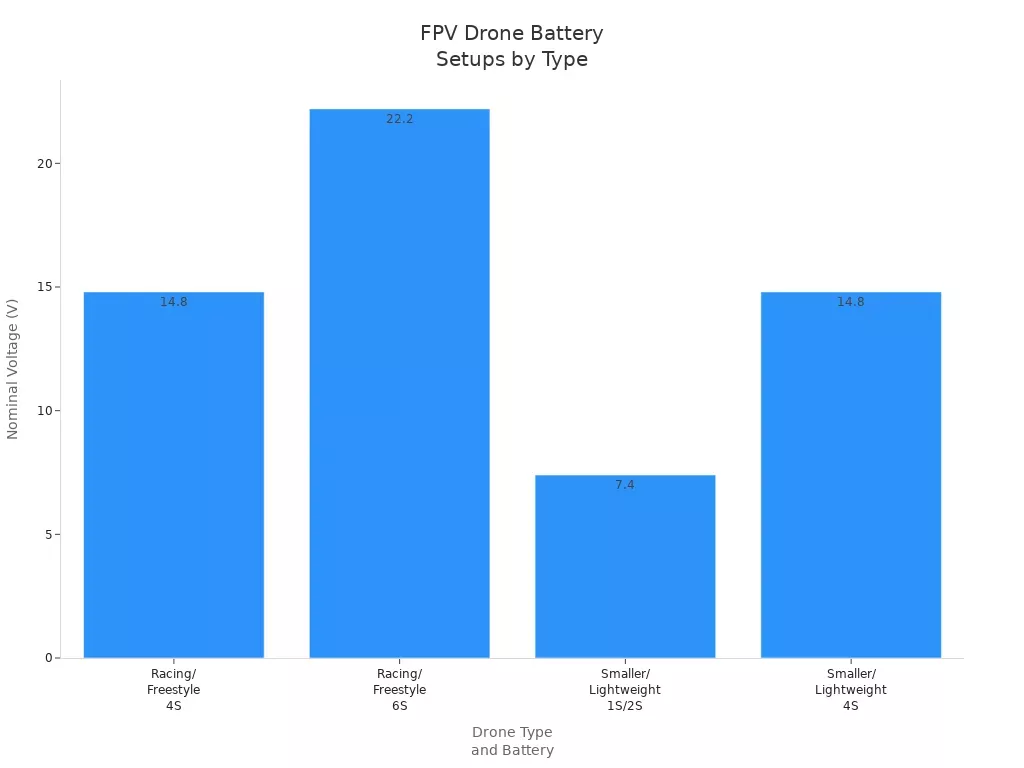
You can use this battery guide to pick the right setup for your fpv drone. The table shows common battery setups for different drone types.
Drone Type | Common Battery Setup | Voltage (Nominal) | Notes |
|---|---|---|---|
Racing/Freestyle Drones | 4S | ~14.8V | Popular for typical 5 inch drones. |
Racing/Freestyle Drones | 6S | ~22.2V | Use if your electronics can handle it. |
Smaller/Lightweight Drones | 1S or 2S | ~3.7V or ~7.4V | Good for keeping the drone light and quick. |
Smaller/Lightweight Drones | 4S | ~14.8V | Helps keep the drone agile. |
Safety tip: Always check your drone's manual before picking a battery. Make sure the battery matches your drone's voltage and capacity limits.
This part of the guide helps you find the best battery for your fpv drone. You can make your battery work better and stay safe by picking the right one for your flying style. Use this battery guide to make smart choices and have fun flying your fpv drone.
You want to pick the best fpv battery for your drone. A good battery selection process helps you get the most out of your flights. Follow these steps to make sure you choose the right one:
Know Your Build Weight
Start by finding your drone's total weight, including the battery. This is called All-Up Weight (AUW). The right battery weight keeps your drone balanced and easy to fly.
Match Battery Voltage to Motor & ESC
Check your drone's manual for the correct voltage. The battery voltage, shown by the number of cells (like 4S or 6S), must match your motor KV and ESC rating. Using the wrong voltage can damage your drone.
Balance Flight Performance and Weight
Pick a battery capacity that fits your flying style. Higher capacity means longer flight time, but it also adds weight. Too much weight can slow your drone.
Choose a Realistic C Rating
Look for a C rating that matches your drone's power needs. Racing drones need higher C ratings for quick moves. Freestyle drones can use a lower C rating.
Consider Connector Type
Make sure the battery connector matches your drone's ESC power lead. The right connector keeps resistance low and helps with battery safety.
Tip: Always check your drone's manual before you buy a new FPV drone battery. If you expect unusual shape, size, wiring, or pack requirements, it is smarter to move beyond standard catalog products and review ZERNE's custom battery solutions to understand their customization process and engineering support.
You need to match the battery's size and weight to your drone. The right fit helps your drone fly better and keeps it safe.
Heavy batteries give you longer flight times, but they can slow your drone.
Light batteries help your drone move faster and turn quickly.
The battery's weight should match your drone's size and what you want to do with it.
If the battery is too heavy, your drone may not fly well.
The battery's shape and connector must fit your drone's design.
If physical fit is a challenge, this is one of the best places to branch into ZERNE's custom curved battery, because custom form factors can solve packaging, weight distribution, and limited internal space problems that off-the-shelf packs cannot.
Note: Always check the battery's physical size and connector type before you buy. This step helps you avoid problems during your flight.
You must find a balance between battery performance and how long your drone stays in the air. This choice depends on your flying style.
Higher C rated batteries give more power for fast moves, but they drain faster.
Lower C rated batteries can last a bit longer, but the difference is small.
The battery's weight changes how your drone flies. A heavier battery can make your drone less agile.
If you use a 4S 1300mAh battery, your drone will feel lighter and more responsive. If you use a 4S 1800mAh battery, you get longer flight time, but your drone may feel slower.
On larger or professional drones, endurance may be improved with more advanced pack architecture rather than simply using a larger single battery. We will explain that design logic in our article on dual and multi-battery drone systems.
You need to be careful when you charge a lipo battery. Always use a balance charger for your fpv battery. This charger keeps all the cells at the same voltage. Pick a charger that is made for lipo batteries. Store your batteries at 3.8V to 3.85V per cell. This helps your fpv battery last longer and stay safe.
Best Practice | Description |
|---|---|
Use a balance charger | Makes sure each cell charges evenly and stops overcharging. |
Maintain storage voltage | Keep at 3.8V–3.85V per cell for best battery health. |
Select the right charger | Use a charger made for lipo batteries to avoid safety problems. |
Tip: Store batteries in a cool and dry place. Keep them away from things that can catch fire. Use fireproof bags for extra safety.
Check your fpv battery before every flight. Look for swelling, rips, or broken connectors. Store batteries at 3.8V per cell in a fireproof box. Charge batteries where air can move around. Let batteries cool down before you charge them again. When you travel, put batteries in a lipo safety bag. Take old batteries to a recycling center after you discharge them to 0V.
Safety Practice | Recommended Action | Risks of Neglect | Tools & Accessories |
|---|---|---|---|
Inspection | Look for swelling and damage | Fire, explosion | Magnifying glass, multimeter |
Storage | Use fireproof box | Chemical damage | LiPo safety bag, voltage checker |
Charging | Ventilated area, balance charger | Overcharging | Smart charger, fireproof vault |
Usage | Stay within C-rating, cooldown | Overheating | Infrared thermometer, flight timer |
Disposal | Discharge and recycle | Environmental hazard | Discharge unit, recycling center |
You can help your fpv battery last longer by doing a few things. Store batteries at 3.8V per cell. Do not let the voltage go below 3.5V. Let batteries cool to room temperature before charging. Only use parallel charging if packs have the same cell count and are within 0.1V of each other.
Store batteries at 3.8V per cell for long-term storage.
Do not go below 3.5V to keep batteries safe.
Let batteries cool before you charge them.
Use parallel charging only when it is safe.
Note: The safe voltage range for lipo batteries is 3V to 4.2V per cell. Stop using the battery if the voltage drops under 3.5V.
You need to avoid mistakes to keep your fpv battery safe. Do not store batteries fully charged or fully empty. Never charge lipo batteries when you are not watching or overnight. Do not mix different voltages or cell counts when charging together. Check batteries for swelling or heat. Stop using any battery that looks damaged.
Do | Don't |
|---|---|
Store at 3.8V per cell | Don't store fully charged or empty |
Use fireproof box | Don't store near metal tools or heat |
Use smart charger | Don't charge without watching |
Let cool before charging | Don't charge hot or puffy batteries |
Land at 3.6V–3.7V per cell | Don't fly until battery is empty |
Check often | Don't use damaged batteries |
Dispose safely | Don't mix voltages when charging |
Safety: Always follow battery safety rules. Taking care of your fpv battery keeps it healthy and keeps you safe from accidents.
You should check your batteries before and after each flight. Swelling is a big warning sign. Gas can build up inside the battery if it gets too hot, is over-discharged, or gets damaged. If you see swelling, stop using the battery right away. Do not try to charge it. Even a small bulge can cause leaks or fire. Always take swollen or broken batteries to a recycling center.
Watch for these problems:
Swelling or puffing
Holes or dents
Worn wires or broken connectors
Alert: Never use or charge a swollen battery. It might catch fire or leak harmful chemicals.
Overheating can hurt your fpv battery and make it unsafe. Always check if the battery is hot after flying. If it feels hot, let it cool down before charging. Overheating happens when you push the battery too hard, like in racing or with lihv packs. Store batteries in a fireproof bag and keep them away from heat to stay safe.
Ways to stop overheating:
Use a smart balance charger
Never leave batteries charging alone
Do not fly until the battery is empty
Let batteries cool off between flights
Tip: Checking your batteries often and storing them safely helps keep them in good shape.
Replace your battery if you see any of these signs:
Swelling or puffing you can see
Gets very hot during normal use or charging
Voltage drops fast during flight
High readings for internal resistance
Smells burnt, looks odd, or has broken wires
Flight times are shorter than normal
If your battery gives a low warning after a short flight or will not hold a charge, you need a new one. Old or damaged batteries can stop working without warning, so always check them before you fly.
Note: Good batteries help you fly longer and keep your drone safe.
You can make smart choices by following a simple fpv beginner guide. Start with a go-to battery that matches your drone's needs and your flying style. Use the table below to remember key steps for safe battery care:
Step | What to Do |
|---|---|
Storage | Store at 3.8V per cell in a cool, dry place. |
Charging | Use a balanced charger and unplug when full. |
Maintenance | Check batteries for swelling or damage. |
Keep learning about fpv battery care from guides, videos, and the community. As you gain experience, try different mah ratings and upgrade your batteries for better flights. Stay safe and enjoy every flight!
If you want to continue from general knowledge into actual product selection, these are the best next pages to visit FPV drone battery page.
LiPo vs lihv means you compare standard lithium polymer batteries to high voltage ones. LiHV batteries charge up to 4.35V per cell. You get more power and longer flight times, but you must use a charger that supports LiHV.
You should inspect your battery for swelling, broken wires, or damaged connectors. Look for any signs of overheating. Always check the battery's safety features before charging or flying.
Store your batteries at 3.8V per cell in a cool, dry place. Use a fireproof bag or box. Keep batteries away from metal objects and direct sunlight.
Let the battery cool down to room temperature before charging. If it feels very hot, check for swelling or damage. Do not use the battery if you see any problems.
You must check your drone's manual. Some drones can use both LiPo and Li-ion batteries. Always match the voltage and connector type to your drone's requirements.