Views: 0 Author: Site Editor Publish Time: 2026-03-09 Origin: Site
Choosing the right fpv drone can feel tricky. If you're a beginner, go for a smaller fpv drone. You'll find it easier to control and safer in tight spaces. Intermediate pilots often pick a medium size for outdoor fpv racing or freestyle. Advanced users might want a large fpv drone for cinematic shots or long-range flights. Size affects speed, handling, and where you can fly. Think about your skill level and where you plan to use your fpv drone before deciding.
If you want to start by understanding the main categories of FPV aircraft before choosing a frame size, read our blog: FPV Drone Types: All You Need to Know.
Begin with a micro or small FPV drone if you are new. These drones are simple to fly. They are safe to use inside your house.
Think about where you will fly your drone. Small drones are good for indoor spaces. Medium drones are better outside, especially when it is windy.
Choose your drone size based on what you want to do. Medium drones can be used for racing, freestyle, and filming. Large drones are best for flying far away.
Your budget is important. Small drones cost less and are good for beginners. Medium and large drones work better but cost more money.
Practice often and try different ways to fly. Join FPV groups to meet skilled pilots and get better at flying.
When you look at common fpv drone sizes, you'll notice four main categories. Each size has its own strengths, weaknesses, and best uses. Let's break down what you can expect from each one.
Micro fpv drones use tiny 1–2 inch propellers and frames between 65–100 mm. You can fly these drones indoors without worry. Their ducted propellers help keep things safe, so you won't damage furniture or hurt yourself. Micro drones are perfect for learning basic fpv skills. You can also use them outside, but only when there's no wind.
Great for indoor flying
Safer for beginners
Easy to carry in your pocket
Short flight times (3–5 minutes)
Not good for windy days
Here's a quick look at how micro drones compare to larger ones:
Feature | Micro FPV Drones | Larger Drones |
|---|---|---|
Safety | Less likely to cause damage; ideal for indoor use | More prone to cause damage due to size |
Affordability | Budget-friendly | Expensive |
Ease of Learning | Great for beginners | Not beginner-friendly |
Portability | Highly portable | Less portable |
Limited Outdoor Use | Struggles in wind | Performs well in wind |
Battery Life | 3–5 minutes | 10–20 minutes |
Video Quality | Lower resolution | Higher quality |
Small fpv drones have propellers between 2.5 and 3.5 inches and frames from 100–180 mm. These drones are lightweight and super agile. You can fly them in tight spaces, making them a good pick for both indoor and outdoor practice. Small drones don't fly as long as bigger ones, but they're easy to control and great for learning tricks.
Agile and quick
Good for tight spots
Shorter flight times
Beginner-friendly
Because smaller builds are more sensitive to battery weight, ZERNE's light drone battery is a useful next step if portability matters to your build.
Medium-sized fpv drones use 4–5 inch props and frames from 180–250 mm. You'll see these drones everywhere in the fpv world. They balance power, stability, and flight time. You can race, freestyle, or even shoot smooth video with them. The 5-inch size is the most popular, so you'll find lots of parts and help online.
Versatile for racing, freestyle, and filming
Handles wind better than smaller sizes
Longer flight times
Plenty of support and resources
Large fpv drones have propellers over 6 inches and frames bigger than 250 mm. You'll use these drones for long-range flights or carrying heavy cameras. They work well in open spaces and can handle tough jobs, like scouting dangerous areas or helping in emergencies. Large drones can fly longer and carry more gear, but they need more space and cost more.
Best for long-range and cinematic shots
Can carry heavy cameras
Useful for search and rescue
Needs lots of room to fly
Not as portable
Tip: Pick the fpv drone size that matches your flying space and goals. Each size offers something different, so think about where and how you want to fly.
If you want to fly inside your house or in small rooms, you should start with a micro drone. These tiny drones fit in your hand and use propellers that measure 1 to 2 inches. Micro drones work well for beginners because they are lightweight, crash-resistant, and quiet. You can practice flying without worrying about breaking things or hurting yourself. Many people call these “Tiny Whoops.” They move slowly and stay stable, so you can focus on learning the basics.
Here's a quick look at the best choices for indoor flying:
Drone Size | Recommended Use | Key Benefits |
|---|---|---|
Micro Drones | Indoor and outdoor practice | Lightweight, crash-resistant, affordable, quiet operation |
You will find that micro drones make learning fun and safe. You can fly them even when it rains outside.
When you want to fly outside, you need a drone that can handle wind and open spaces. Medium drones with 4 to 5 inch propellers give you more power and longer flight times. But for most beginners, a 3.5 inch drone is the sweet spot. It is not too big or too small. You get enough speed to practice new moves, but you still keep control. These drones help you build your fpv skills before moving up to bigger models.
Check out this table to see how different drones compare for learning outdoors:
FPV Drone Type | Typical Size | Best For | Flying Style | Skill Level |
|---|---|---|---|---|
Tiny Whoop | 1.6–2.5 inch | Indoor flying, basic training | Slow, stable, crash-resistant | Beginner |
Cinewhoop | 2.5–3.5 inch | Cinematic video, close-range filming | Smooth, controlled | Beginner–Intermediate |
FPV Racing Drone | 5 inch | Racing, freestyle, fast action shots | Very fast, highly responsive | Intermediate–Advanced |
Cinewhoops are a special kind of fpv drone that use 2.5 to 3 inch propellers. They are perfect for beginners who want to try both indoor and outdoor flying. Cinewhoops fly slow and steady, which helps you practice new skills without feeling nervous. You can fly them through tight spaces and around obstacles. Their design keeps the propellers safe, so you do not have to worry about crashes.
Here's why cinewhoops are great for learning:
They offer slow and stable flight, which is perfect for beginners.
You can fly them in small spaces and learn to control your drone better.
They have advanced stabilization, so your video looks smooth.
You can carry them anywhere and set them up fast.
If you want to start with fpv drones for beginners, cinewhoops and 3.5 inch drones give you the best mix of safety, control, and fun. You will build your learning step by step and get ready for bigger challenges as your skill level grows.
You want your drone to move fast and smooth. Small fpv drones are quick and easy to turn. Their batteries do not last long. Medium drones balance speed and flight time well. You can race, do tricks, or film with them. Large fpv drones carry heavy cameras and fly longer. They need more space to fly. Bigger drones handle wind better outside. Smaller drones are good indoors and in tight places.
Tip: Choose a medium or large fpv drone for longer flights. Small fpv drones are easier for quick practice.
All drones need care to stay safe and work well. Fixing problems early saves money. Here are some things to know:
Propellers break first. Small fpv drones cost less to fix.
Large fpv drone motors get stressed and need repairs more.
Frames and arms break in crashes. Bigger drones cost more to fix.
A drone lasts longer if you take care of it. Preventive care costs less than fixing big problems.
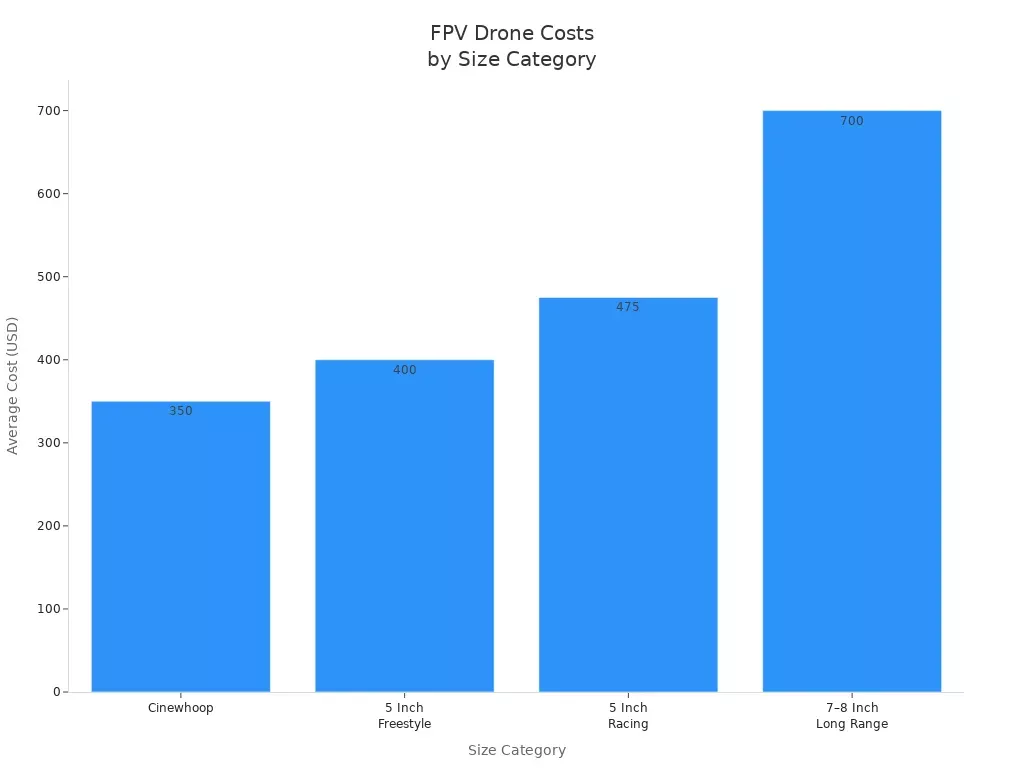
You may wonder how much each drone size costs. Prices change with features and upgrades. Look at this table:
Size Category | Estimated Cost | Key Features/Components |
|---|---|---|
Cinewhoop | $250 – $450 | High-torque motors, ducted frame, GoPro compatibility |
5 Inch Freestyle | $300 – $500 | 2207/2306 motors, separate FC + ESC, analog/digital FPV |
5 Inch Racing | $350 – $600 | Lightweight motors, strong ESCs, aggressive flying |
7–8 Inch Long Range | $500 – $900+ | Large motors, high-capacity batteries, GPS systems |
Digital FPV System Upgrade | $200 – $260 (DJI) | HD video feed, requires compatible goggles costing $300+ |
Upgrades make your drone work better. You can add new cameras, motors, or digital systems. Large fpv drones cost more to upgrade.
Safety rules depend on drone size and weight. You need to know if your drone needs registration. Here is a quick guide:
Drone Size/Weight | Regulation Requirement |
|---|---|
Under 250 grams | No registration needed |
Heavier drones | May require registration, certification, or licensing |
Small fpv drones usually do not need registration. Large fpv drones often need paperwork. Always check local rules before you fly.
Picking the perfect size for your fpv drone can feel overwhelming, but you can make it simple by focusing on a few key considerations for choosing. Let's break down how you can match your drone to your skill level, flying environment, intended use, and budget. Understanding fpv drone sizes will help you get the most out of your flying experience.
Your skill level plays a big role in choosing the right size. If you're just starting, small drones are your best friend. They're easy to control, safe, and don't break the bank. As you get better, you might want to try medium drones. These give you more power and let you try new tricks. Advanced pilots often go for large drones because they can handle more complex flights and carry heavy cameras.
Here's what you should think about:
Beginners should start with micro or small drones. These are easy to fly and fix.
Intermediate pilots can move up to medium drones for more speed and control.
Advanced users can handle large drones for long-range or cinematic flights.
Check out this table to see how drone types and sizes fit different skill levels and uses:
Drone Type | Motor KV | Prop Size | Battery | Special Features |
|---|---|---|---|---|
Racing | 2207 / 2306 (2500KV+) | 5 inch | 6S | High thrust, minimal weight |
Freestyle | 2306 / 2207 (1900-2100KV) | 5 inch | 6S | Balanced power and control |
Cinematic | 2004-2204 (1500-1800KV) | 4-7 inch | 6S/Li-Ion | Smooth throttle, vibration dampening |
Long Range | 1804-2004 (1200-1500KV) | 7 inch+ | 6S/Li-Ion | GPS, larger antennas |
If you want to compare battery directions for different FPV sizes and use cases, ZERNE's FPV drone battery is a practical place to continue.
Where you plan to fly makes a big difference. Small drones work best indoors or in tight outdoor spaces. Medium drones shine in parks or open fields. Large drones need lots of room and do well in wide-open areas.
Let's look at some environmental factors:
Environmental Factor | Impact |
|---|---|
Interference | Urban areas with Wi-Fi or cell towers can mess with your drone signals. |
Weather | Cold weather drains batteries fast. Wind makes flying harder, especially for small drones. |
If you fly in cities, small drones are easier to control and less likely to lose signal. For windy days or big fields, medium drones handle better. Large drones are best for open country or mountain flying.
Tip: Always check the weather before you fly. Wind and cold can change how your drone performs.
Think about what you want to do with your fpv drone. Do you want to race, do tricks, film smooth videos, or fly far away? Each use needs a different size.
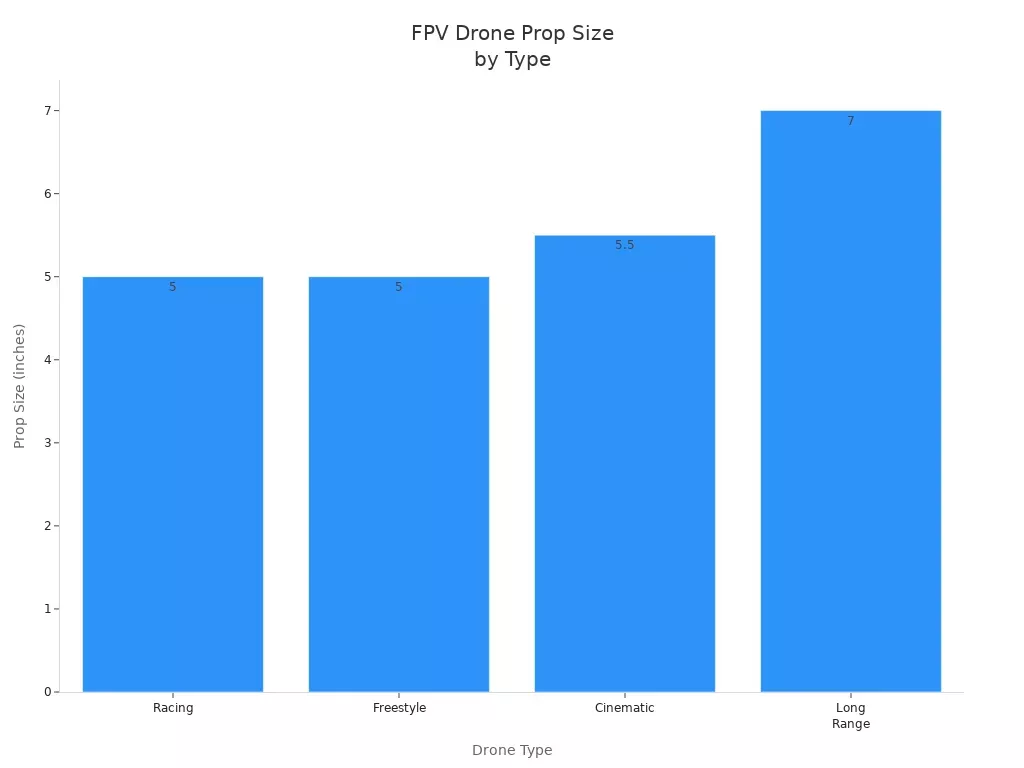
Racing: Most pilots use 5-inch medium drones. They're fast and nimble.
Freestyle: Medium drones (5-inch) are also great for tricks and flips.
Cinematic: Large drones (7-inch or more) carry heavy cameras and fly steady for smooth shots. Some pilots use 5-inch frames with extra stabilization.
Long-range: Large drones (7-inch+) can hold big batteries and fly far.
Here's a quick chart to show how prop size changes for each use:
If you want to try everything, medium drones give you the most options. They're the most popular for a reason.
Your budget will help you narrow down your choices. Small drones cost less and are great for learning. Medium drones cost more but offer better performance and more features. Large drones are expensive and best for serious pilots.
Here's a table to help you compare:
Drone Size | Price Range | Description |
|---|---|---|
Micro Drones | $100–$300 | Affordable and perfect for beginners. |
Small Drones | $200–$500 | A step up for better performance and control. |
Medium Drones | $400–$1,000 | More expensive, but they offer great versatility. |
Large Drones | $1,000+ | For serious, professional use and long flights. |
When you pick the perfect size, remember that bigger batteries give you longer flights, but they also add weight. You need to balance battery size, drone weight, and your budget. If you want to save money, choose efficient parts and keep your drone light. This way, you get good performance without spending too much.
Here are some tips to help you balance budget and performance:
Choose efficient motors and batteries to get the most out of your drone.
Keep your drone as light as possible for better flight times.
Think about what features you really need before you buy upgrades.
Choosing the right size for your fpv drone means thinking about your skill, where you fly, what you want to do, and how much you want to spend. Small drones are best for learning and tight spaces. Medium drones work for most pilots and uses. Large drones are for pros who need long flights or heavy cameras. Use these tips to find the drone that fits you best and enjoy your flights!
You have lots of choices when picking your FPV drone size. Here's what matters most:
Bigger frames need bigger, pricier controllers.
More features mean you need a larger controller.
Beginners do best with regular-sized controllers for easy flying and lower cost.
Pick a drone that fits your skill and flying space. Start small, then move up as you grow. Want to get better?
Practice flying often.
Try new flying styles and places.
Join FPV groups to learn from others.
You'll have more fun and fly safer when you match your drone to your needs! If you need help choosing the right battery direction for your FPV drone size, contact us for technical support.
You should start with a micro or small FPV drone. These drones are easy to control and safe for indoor flying. You can learn the basics without spending a lot of money or worrying about crashes.
No, you should not fly medium or large drones indoors. They need more space and can break things. Stick with micro drones for indoor practice. You will stay safe and protect your home.
Not always. Bigger drones can carry larger batteries, but they also weigh more. Flight time depends on battery size, drone weight, and how you fly. Medium drones often give you the best balance.
If your drone weighs less than 250 grams, you usually do not need to register it. Heavier drones may need registration. Always check your local rules before you fly.