
Views: 0 Author: Site Editor Publish Time: 2026-02-27 Origin: Site
You need to think about a few important things when picking a drone battery for work. These things are battery type, capacity, voltage, discharge rate, weight, size, and who made it. The right battery helps your drone work better and fly for more time. It is important to charge and store batteries the right way to stay safe.
Battery capacity decides how long your drone can fly.
Taking care of your battery helps your drone fly longer and keeps it safe.
Make sure the battery matches your drone and balance the battery’s size and weight for the best results.
Pick the right battery type for your drone. LiPo batteries help your drone go fast. Li-Ion batteries let your drone fly longer.
Always look at the battery capacity, called mAh. This helps your drone fly as long as you want. A bigger capacity means your drone can fly longer.
Check your battery’s health often. Watch for swelling or less power. This keeps your drone safe and helps stop crashes.
Use the charger the maker says to use. This stops damage to your battery. Charging the right way makes your battery last longer and work better.
Make sure the battery weight fits your drone. A balanced drone flies smoother and saves energy.
When you choose the right drone battery, you improve how your drone flies. The type of battery you use changes speed, altitude, and flight time. For example, lithium-polymer batteries give high power for fast moves and quick turns. Lithium-ion batteries hold more energy, so your drone can fly longer and reach higher places. Some new solid-state batteries make flying safer and more stable, even in tough weather.
LiPo batteries help racing drones go faster and turn quickly.
Li-ion batteries work well for drones that need to stay in the air for a long time.
The battery you pick affects how long your drone can fly and how well it responds to your controls.
Professional drone operators think about what they want to do with their drone. If you want to take photos or do long flights, you need a battery that lasts. If you carry heavy cameras, you must balance the weight so your drone does not use too much energy. Good balance and the right battery help your drone fly smoothly and efficiently.
You must care about safety hazards when you pick a drone battery. High-quality batteries give steady power and help your drone work every time you fly. If you use a poor battery, you may see problems like swelling, short flight times, or sudden drops in power. These issues can cause crashes or damage your drone.
Swelling or bulging means the battery is not safe.
Shorter flight times show the battery is getting weak.
Unstable voltage can make your drone hard to control.
Overheating is a sign of danger and can lead to safety hazards.
A good drone battery keeps your drone safe and makes it last longer. Reliable batteries protect your drone from sudden failures. You should always check your battery for signs of trouble and replace it if you see any problems. This way, you keep your drone safe and enjoy flying with confidence.
If you want a more focused comparison of lifespan, runtime, and power delivery between the two main chemistries, read Li-ion vs LiPo Batteries for Drones: Which Lasts Longer.
Picking the right drone battery helps your drone work well. You should learn about the main types of rechargeable batteries. Each battery type has special things that change flight time, power, and safety.
LiPo batteries are used a lot in professional drones. They are light and give power quickly. These batteries help your drone move fast and turn easily. Racing drones often use LiPo batteries.
LiPo batteries have high energy density. This lets your drone fly longer.
You get smooth control because LiPo batteries give steady power.
The light design makes your drone easier to move.
Tip: If you want your drone to fly longer, pick a LiPo battery with more than 5000mAh. Make sure the battery is not too heavy for your drone.
LiPo batteries need careful care. They can break if you overcharge or drop them. Always check your battery for swelling or damage before flying.
Li-Ion batteries give more energy and last longer than LiPo batteries. These batteries are heavier, but you can recharge them many times. If you use your drone for photos or need long flights, Li-Ion batteries are a good pick.
Li-Ion batteries last longer. You can recharge them many times.
You get more energy, so your drone stays in the air longer.
These batteries are safer and more steady than LiPo batteries.
Battery Type | Cycle Life | Key Advantages | Limitations |
|---|---|---|---|
Li-ion | Longer | Higher energy capacity, more charge cycles, stability | Lower maximum discharge rate, standard form factors |
LiPo | Shorter | Lightweight, high discharge capabilities | Requires careful handling, sensitive to damage |
Li-Ion batteries are good for drones that need to fly for a long time. They do not give fast power like LiPo batteries, but they work steadily.
LiHV batteries are a newer kind of rechargeable battery for drones. These batteries have higher voltage than LiPo or Li-Ion batteries. You get more power, which helps your drone go faster and lift heavy things.
Higher voltage means your drone’s motors spin faster and get more power.
You can pick different voltage setups for your drone.
Voltage Configuration | Nominal Voltage | Impact on Performance |
|---|---|---|
4S | 14.8V | Good for standard drones, balances power and efficiency |
6S | 22.2V | Gives more power for heavy lifting and speed |
12S | 44.4V | Used for advanced drones needing lots of power |
3S | 11.1V | Saves energy, good for longer flights with less power needed |
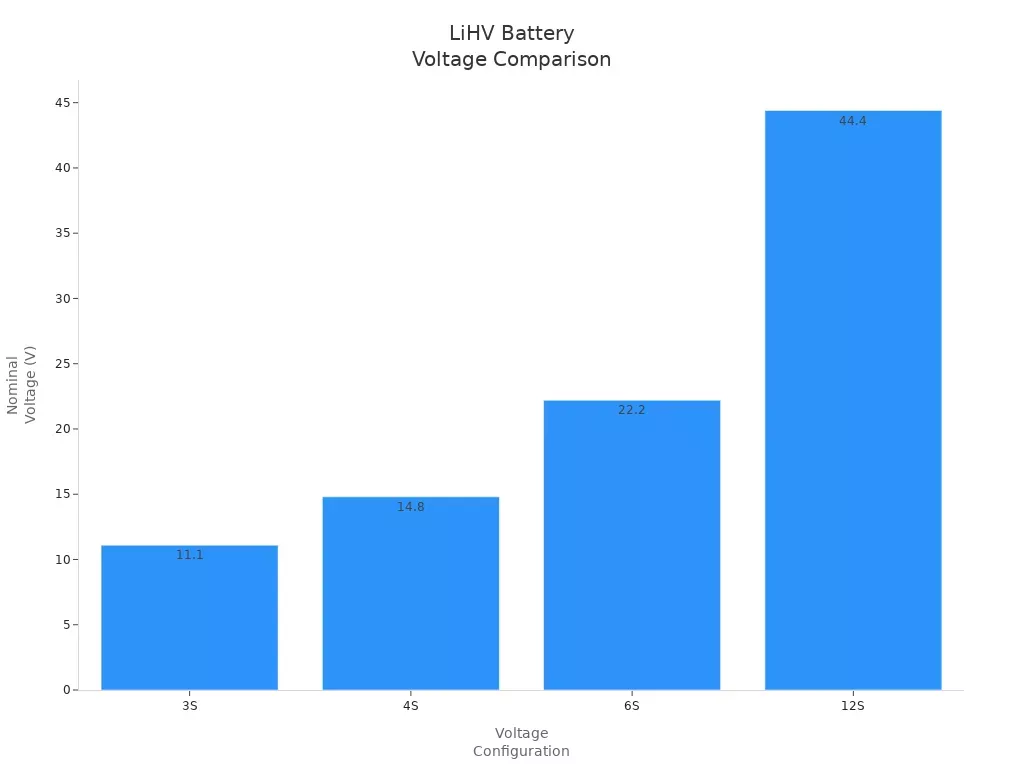
You can pick a 4S battery for normal drones or a 6S battery for drones that need more power. Higher voltage batteries make your drone go faster, but they use more energy and may make flight time shorter.
You should compare the main types of rechargeable batteries to find the best one for your drone.
Battery Type | Key Features | Energy Density Comparison |
|---|---|---|
Semi-Solid-State Li-ion | High energy, fast discharge, long life, light, compact | 30-35% better than Li-ion, 20% better than LiPo |
Li-ion | Good discharge, strong energy, lasts long | Good |
LiPo | Lightweight, quick power, easy for racing | Standard |
LiPo batteries are light and give quick power. They are best for racing and fast moves. You must be careful because they can break easily.
Li-Ion batteries last longer and are safer. They are heavier and do not give quick power like LiPo batteries.
LiHV batteries give more voltage and power. You can use them for heavy lifting or speed, but they use more energy.
Note: Lithium batteries are used a lot in professional drones. You must balance battery size and weight. If you want longer flights, pick a battery with more than 5000mAh, but check if your drone can carry the extra weight.
You can find the best battery by matching the battery type to your drone’s needs. Think about flight time, power, and safety. Always check your battery before flying and use the right way to charge it.
If your project needs higher voltage output for heavier payloads or stronger performance, ZERNE’s high-voltage battery solutions are a practical reference.
You should look at battery capacity when picking a drone battery. Battery capacity shows how much energy the battery can hold. This is measured in milliamp-hours, or mAh. If the battery has more capacity, your drone will fly for a longer time. Professional drones use batteries from 4,000 mAh to over 20,000 mAh. The best capacity depends on what you want your drone to do.
FPV racing drones use batteries with 650–1300 mAh.
Freestyle drones use batteries with 1500–2600 mAh.
Consumer camera drones use batteries with 3,000–6,000 mAh.
Industrial drones and long endurance UAVs use batteries with 10,000 mAh or more.
Tip: For longer flights, choose a battery with higher capacity. Make sure your drone can carry the extra weight.
If you want to compare different pack formats and voltage combinations in real products, ZERNE’s lithium battery pack is a useful next step.
Voltage is important for how well your drone battery works. Voltage tells you the strength of the electricity from the battery. Drone batteries show voltage as “S” ratings, like 3S, 4S, 6S, or 12S. Each “S” means there is one cell in the battery. More cells give higher voltage.
3S batteries have 11.1V.
4S batteries have 14.8V.
6S batteries have 22.2V.
12S batteries have 44.4V.
Higher voltage makes your drone’s motors spin faster and gives more power. If your drone needs to lift heavy things or move fast, you need a battery with higher voltage. For most drones, 4S or 6S batteries give a good mix of power and efficiency. You must match the voltage to what your drone needs. Using the wrong voltage can hurt your drone or make it work badly.
Note: Drone battery voltage changes flight time and how well your drone works. Higher voltage can mean you do not need as much capacity, but it might use more power.
The discharge rate, or C rating, shows how fast a battery can give out energy. You need to check the discharge rate for professional drones. Racing drones and drones that carry heavy things need batteries with high discharge rates. The C rating tells you how much current the battery can safely give.
Drone Type | Battery Type | Capacity (mAh) | C-rating |
|---|---|---|---|
5-inch Racing Drone | 4S & 6S | 1300–1550 | 150C or higher |
Long-range/Freestyle | 6S | 1050–1300 | High C rating |
Professional drones often use batteries with C ratings from 20C to 50C or more. If your drone needs quick bursts of power, pick a battery with a high discharge rate. For normal flying, a lower C rating (10C to 20C) is fine.
Tip: Always check the discharge rate so your battery can handle your drone’s power needs.
Weight and size are important when you pick a drone battery. Heavier batteries can store more energy, but they also make your drone use more power. You need to balance battery weight with how much your drone can carry. If you use a heavy battery, your drone might fly for less time and not work as well.
Keep payload weight low to help your drone work better.
Figure out Maximum Takeoff Weight (MTOW) before you fly.
Balanced weight helps all motors work the same.
If the weight is not balanced, some motors work harder. This uses more power and makes your drone less efficient. Balanced weight helps your drone fly smoothly and makes the battery work better.
Note: Good drone flights depend on finding the right balance between battery weight and how well your drone works. Heavy loads use up batteries faster and can cut flight times by up to 80%.
Cycle life means how many times you can charge and use a battery before it gets weak. Most professional drone batteries last for 200 to 300 cycles if you use them normally. If you take good care of your battery, you can get over 400 cycles. If you only use half the battery each time, it can last up to 1,200 cycles.
Batteries that last longer need to be replaced less often.
Fewer replacements save money for people who use drones.
You should keep track of cycle life to know when to get new batteries. Using batteries with longer cycle life saves money and keeps your drone working well.
Tip: Take care of your battery to make it last longer and save money.
You should check for certifications before buying a drone battery. These certifications show the battery is safe and works well in many places. Some important certifications are:
UN38.3 Transportation Testing lets you ship batteries safely by air.
CE Marking means the battery follows European safety rules.
FCC Certification checks if the battery is safe around electronics.
ISO 9001 Quality Management shows the company uses good quality steps.
Battery Passport will soon be needed in the EU.
IEC 62133-2 is for batteries with alkaline or non-acid electrolytes.
SAE AS5714 is for lithium batteries used in airplanes.
RTCA DO-311A sets rules for lithium batteries in aviation.
NFPA 855 gives rules for putting in energy storage systems.
Big drone battery makers must follow these rules. In North America, FAA rules focus on safety and battery care. The European Union has new rules for safety and being green. Countries like China and Japan have their own tests. Always check if the battery maker follows these rules.
If certifications are part of your evaluation process, ZERNE’s certificates page is also worth checking before you finalize a battery supplier.
You should pick a drone battery maker with a good name. A trusted maker gives you safe batteries that work well. Read what other drone users say in reviews. Look for brands that follow UN38.3 and IEC 62133 rules. These brands care about safety and quality. You can trust them to make batteries that last and work better. If you see lots of good reviews and certifications, the brand is reliable.
Tip: Always check online forums and drone groups for real feedback about drone battery makers.
Warranty and support help you feel safe when you buy a battery. Good companies have clear warranty rules and easy support. Here is a table that shows what two top makers offer:
Manufacturer | Warranty Duration | Coverage Details | Exclusions |
|---|---|---|---|
Mavdrones | 1 year | Covers non-accidental issues; repair solutions available for mishandling. | Batteries and propellers |
Bestway Drones | 12 months | Covers manufacturer defects; requires proof of purchase and may need additional data for claims. | Negligent damage |
You can call, email, or visit Mavdrones for help. Bestway Drones needs proof you bought the battery and when you started using it. A good maker gives you fast help and clear answers. Always check the warranty before you buy a battery.
Note: Picking a drone battery maker with good support and warranty keeps your drone safe and protects your money.
You can help your drone battery last longer by using good charging and storage habits. Always use the charger that the maker says is safe. This keeps your battery safe and balanced. Charge your battery when the room is not too hot or cold. Try not to use fast charging unless you really need it. Slow charging is better for the battery cells. Let your battery cool down after flying before you charge it again.
Keep your battery charged between 40% and 60% when you store it. This stops chemical stress from hurting the battery. For long storage, keep the charge between 50% and 60%. Put batteries in a cool, dry place. Keep them away from heat and water. Use fireproof bags or hard cases for extra safety. If you do not use your battery often, check and recharge it every three months.
Tip: Write down how many times you use each battery. This helps you know when to get new ones and stops sudden problems.
Be careful when you handle your batteries. This keeps your drone safe. Always look for swelling, leaks, or damage before you fly. Calibrate smart batteries by fully draining and charging them sometimes. If you use parallel charging boards, make sure all batteries are the same type, voltage, and charge level.
Use cooling fans while charging or between flights. This keeps the battery cells from getting too hot. Watch for trouble signs like shorter flight time or overheating. Get rid of old batteries safely. Drain them all the way, tape the ends, and use a recycling program.
Note: Taking care of your battery helps it give steady power. This makes your drone work well every time you fly.
You need to know when to change your battery so you do not have problems. Most high-performance batteries last for 200 to 300 uses. After this, they wear out faster. Look for these signs:
The battery swells or does not sit flat.
You see sudden drops in battery power during flight.
Your drone lands early even if the remote shows enough power.
The app warns about cell damage or fake batteries.
Change your battery right away if you see any of these signs. This keeps your drone safe and ready for every flight.
You can pick the right drone battery by checking voltage, capacity, and C-rating. Make sure these match what your drone needs. Choose batteries from trusted companies with safety certifications. This helps you stay safe and avoid problems. Try to balance how long your drone flies with the battery’s weight. This makes your drone fly well and safely. Use this checklist to take care of your battery:
Check for damage after every flight.
Store batteries at the correct voltage in a cool, dry spot.
Get a new battery if you see any signs of damage.
If you need help matching voltage, capacity, discharge rate, or pack size to a professional drone platform, contact us for technical support.
You should use lithium-polymer batteries for most professional drones. These batteries are lightweight and give high power. They help your drone fly longer and respond quickly.
You need to replace your battery if you see swelling, leaks, or sudden drops in power. Shorter flight times and warning messages also mean it is time for a new battery.
You must use the charger recommended by the manufacturer. Using the wrong charger can damage your battery and make it unsafe. Always follow the instructions for charging.
Heavy batteries let your drone fly longer, but they can reduce speed and make your drone harder to control. You should balance battery weight with your drone’s maximum takeoff weight.
You should store your battery in a cool, dry place. Keep the charge between 40% and 60%. Use fireproof bags or hard cases for extra safety.