
Views: 0 Author: Site Editor Publish Time: 2026-02-24 Origin: Site
If you want your drone battery to last longer, Li-ion is usually better than LiPo. Here is how they compare in the Li-ion vs LiPo debate:
Factor | LiPo | Li-ion |
|---|---|---|
Average Cycle Life | 300–500 cycles | 500–1,000 cycles |
Energy Density | Moderate | High |
Peak Power | Very high | Moderate |
Safety (Swelling, Runaway) | Lower | Higher |
How long a battery lasts, how fast it delivers power, and how you use it are all important factors. When you choose between Li-ion and LiPo, consider what you need most.
Li-ion batteries can be used many times. They last for 500 to 1,000 cycles. This makes them good for long flights.
LiPo batteries give strong power fast. They are great for racing and quick moves. But they wear out sooner, after 300 to 500 cycles.
Pick Li-ion if you want steady power and long use. Pick LiPo if you need high power and fast charging.
Always check if your battery is healthy. Do not overcharge it. This helps your battery last longer and keeps you safe.
Keep batteries at 40-60% charge. Store them in a cool place. This helps them work well and last longer.
Let's break down the li-ion vs lipo debate with a simple table. This will help you see how each battery type stacks up for your drone.
Feature | Li-ion Batteries | LiPo Batteries |
|---|---|---|
Construction | Cylindrical or prismatic, strong and stable | Pouch cells, flexible but more fragile |
Chemistry | Safer, lasts longer, steady power | High burst power, needs careful handling |
Performance | Great for long flights and steady use | Best for quick, powerful moves |
Safety | Handles bumps and mistakes better | Can swell or fail if damaged |
Usable Cycles | 500–1,000 cycles | 300–500 cycles |
Initial Cost | Higher | Lower |
Replacement Frequency | Lower (lasts longer) | Higher (wears out faster) |
Charging Time (5,000mAh) | About 2 hours (50W charger) | About 30 minutes (100W charger) |
Environmental Impact | Recyclable, less waste if disposed properly | Recyclable, but wears out faster |
Tip: If you want a drone battery that lasts longer and needs fewer replacements, li-ion usually wins. If you want fast charging and high power for racing, lipo might be your pick.
If you want a broader look at voltage, capacity, C-rating, storage, and safety beyond chemistry alone, see our The Ultimate Guide to FPV Battery.
You might wonder what really sets li-ion vs lipo apart for your drone. Here's what you need to know:
Shape and Build: Li-ion batteries come in hard cases, so they resist swelling and damage. Lipo batteries use soft pouches, which makes them lighter and easier to fit in small spaces, but also more likely to get damaged.
Power Delivery: Lipo batteries give your drone a big burst of power. That's why racers love them. Li-ion batteries deliver steady energy, which is perfect for long, smooth flights.
Lifespan: Li-ion batteries last longer. You can charge and use them more times before they wear out. Lipo batteries wear out faster, especially if you push them hard.
Cost: Lipo batteries cost less at first, but you'll need to replace them more often. Li-ion batteries cost more up front, but you save money in the long run because they last longer.
Charging: Lipo batteries charge faster. You can get back in the air quickly. Li-ion batteries take more time to charge, so you might need to plan ahead.
Safety: Li-ion batteries handle bumps and mistakes better. Lipo batteries can swell or even catch fire if you don't treat them right.
Environment: Both types should be recycled. Proper recycling keeps harmful stuff out of the ground and helps save resources.
If you fly your drone for fun and want to save money, lipo batteries are a good start. If you fly for work or need long flights, li-ion batteries are a smart choice.
You now have a clear view of the li-ion vs lipo battle. The right drone battery depends on what you want: more power, longer life, or lower cost.
When you look at how long your battery will last, you need to think about cycle life. A cycle is one full charge and discharge. Every time you use your drone and then recharge, you complete a cycle. Most Li-ion batteries give you a cycle life of 500 to 1,000 cycles. LiPo batteries usually offer a cycle life of 300 to 500 cycles. If you fly your drone every day, you will notice the difference in how many cycles each battery can handle before it starts to lose power. The more cycles your battery can take, the longer it will last. If you want your drone battery to last, always keep an eye on the cycle life. Try not to overcharge or drain your battery too much. This helps you get the most cycles out of every battery.
Cycle life is not the only sign of battery aging. If you want to understand why voltage sag, heat, and reduced runtime often get worse over time, read our article about The Internal Resistance of a Drone Battery.
Discharge rates show how fast your battery can deliver power to your drone. LiPo batteries have high discharge rates, often between 20C and 50C. This means they can give your drone a lot of power very quickly, which is great for racing or fast moves. Li-ion batteries have lower discharge rates, but they last longer and keep a steady flow of power. Here's a quick look:
Battery Type | Discharge Rate | Longevity | Performance Characteristics |
|---|---|---|---|
LiPo | High (20C-50C) | Shorter | Ideal for high-power applications like drones |
Li-ion | Lower | Longer | Better stability under moderate loads |
If you push your battery too hard with high discharge rates, you will shorten its cycle life. You might also see a sudden drop in power at the end of a cycle, especially with LiPo batteries. Always match your battery's discharge rate to your drone's needs to get the best cycle life.
How you use and care for your battery makes a big difference in its cycle life. Charging habits matter a lot. Overcharging or letting your battery drain all the way can cut its cycle life short. Try to keep your battery charged between 20% and 80%. Storing your battery at 40-60% charge and in a cool place (about 59–77°F) helps keep the cycle life high. If you fly your drone with lots of quick turns or heavy loads, your battery will work harder and wear out faster. Hot or cold weather can also hurt your battery's cycle life. High heat speeds up battery aging, while cold makes your battery less powerful. Always check your battery for damage, because things like punctures or swelling can end a cycle life early and even cause safety problems.
Tip: Treat your battery with care, and you will get more cycles and longer flights from your drone battery.
Lipo batteries do not last as long as some other types. Most lipo batteries work for about 300 to 500 cycles. After that, they start to lose power. If you use your drone every day, the battery wears out faster. Lipo batteries are popular because they are light and fit in small spaces. You can change them quickly, but you need new ones more often. If you want a battery that lasts longer, you should look at other choices.
Tip: Do not drain your lipo battery all the way. Keep it charged between 20% and 80%. This helps you get more cycles.
Lipo batteries are great when you need lots of power. They give quick bursts of energy. This makes them perfect for racing drones or fast moves. You can see how lipo compares to other batteries in the table below:
Battery Type | Power Output | Energy Density (Wh/kg) | Flight Duration |
|---|---|---|---|
LiPo | High, rapid discharge | 100-265 | Shorter flight times |
Li-ion | Steady, consistent | 150-300 | Longer flight times |
If you want your drone to move fast or carry heavy things, lipo batteries give you the power you need. Flight times are shorter because lipo uses energy quickly. For racing or tricks, lipo is the best choice.
Safety matters when you use lipo batteries. These batteries can swell, catch fire, or leak if you damage them or charge them wrong. Always check your battery for swelling or damage. The table below shows the main safety concerns:
Safety Concern | Description |
|---|---|
Health Hazards | Touching the inside of the battery can be dangerous. Avoid contact with the substances. Get medical help if you are exposed. |
Fire Hazards | LiPo batteries have materials that can burn. Stop overheating or fire from happening. If there is a fire, call the fire department and do not breathe the smoke. |
If your lipo battery swells or gets hot, stop using it right away. Always store your battery in a safe place. Use a fireproof bag if you can. You can enjoy your drone more when you stay safe.
Note: Be careful with lipo drone batteries. You keep yourself and your drone safe when you follow safety steps.
If battery safety and consistency matter to your project, you can also review ZERNE's quality control system for more background on testing and battery reliability.
You want your battery to last as long as possible. Li-ion drone batteries give you more cycles than most other types. You can expect between 500 and 1,000 cycles from a li-ion battery. That means you can charge and use your battery many times before it starts to lose power. If you fly your drone often, you will notice that li-ion batteries keep going strong for a long time. You do not need to replace them as often as other batteries. This makes li-ion a smart choice if you want your drone battery to last.
Tip: Try not to drain your li-ion battery all the way. Keep it charged between 20% and 80%. You will get more cycles and longer life.
Li-ion batteries stand out because of their high energy density. This means they store more power in a smaller package. You get longer flight times for your drone, especially if you carry heavy loads or use a bigger drone. Here is how energy density compares:
LiPo batteries usually have an energy density between 100-265 Wh/kg.
Li-ion batteries often reach 150-300 Wh/kg.
Higher energy density in li-ion batteries leads to longer flights and more time in the air.
If you want your drone to stay up longer, li-ion drone batteries are the way to go. You can fly farther and do more with each charge.
Safety matters when you pick a battery. Li-ion batteries come with strong casings and built-in protection circuits. You get lower risks of fires, explosions, or thermal runaway. Li-ion batteries are more stable and less likely to fail in a dangerous way. Take a look at this table:
Battery Type | Safety Features | Risks |
|---|---|---|
Li-ion | Robust casings, protection circuits | Lower risk of fires and explosions |
LiPo | Soft, flexible packaging | More risk from damage, punctures, and fires |
Li-ion batteries handle bumps and mistakes better than LiPo batteries. You do not have to worry as much about swelling or sudden failure. If you treat your battery with care, you will stay safe and get the best performance.
Do you want your drone to stay in the air for as long as possible? You should look at the lipo vs li-ion debate with endurance in mind. Li-ion batteries shine when you need long endurance. They pack more energy into the same space, so your drone can fly farther and longer. Many pilots choose li-ion for mapping, search and rescue, or professional photography because these batteries keep the drone flying for extended missions.
Li-ion batteries are the top pick for long endurance flights.
You get longer flight times with li-ion compared to lipo.
Li-ion batteries work best for drones that need to cover big areas or stay up for hours.
You might see commercial drones with li-ion batteries because they need reliable, long endurance power. If you want to fly for fun and stay in the air longer, li-ion is your friend. Lipo batteries can't match the long endurance of li-ion, but they do charge faster. That's helpful if you need to get back in the air quickly, but you'll still need more battery swaps.
Tip: For long endurance flights, always check your battery's energy density. Higher numbers mean more time in the sky.
If you love speed and sharp turns, you need a battery that delivers instant power. In the lipo vs li-ion debate, lipo wins for racing and high power. Lipo batteries give your drone quick bursts of energy. This lets you zip around corners, climb fast, and pull off wild tricks. Racing drones almost always use lipo because they need high discharge rates and lots of power in a short time.
Here's a quick look at how each battery type performs in racing:
Battery Type | Performance Characteristics |
|---|---|
LiPo | High-power applications, rapid discharge rates, ideal for racing drones and acrobatic flight |
Li-ion | Steady, consistent power output, suitable for longer flights and professional applications like aerial photography |
You want a battery that can handle high discharge rates for racing. Lipo batteries support dynamic flight and fast accelerations. Li-ion batteries can't keep up with the power demands of racing. If you want to win races or do stunts, lipo is the way to go.
High discharge rates make lipo perfect for quick moves.
Lipo batteries support performance-oriented flights.
Li-ion batteries work better for steady, long endurance flights.
Note: Always check your drone's specs before choosing a battery. Using the wrong type can hurt performance or even damage your drone.
Safety should always come first when you pick a battery for your drone. Both li-ion and lipo batteries need careful handling, but there are some differences you should know. Li-ion batteries have strong cases and built-in protection. They handle bumps and drops better. Lipo batteries use soft pouches, so they can swell, leak, or catch fire if damaged.
Here are some real-world safety facts:
The FAA has reported 38 incidents involving lithium batteries on aircraft this year, including smoke, fire, or extreme heat.
Last year, there were 89 incidents related to lithium batteries.
The FAA says you should always inspect your battery and handle it with care to prevent problems.
You can fly safely with both battery types if you follow the rules. Always check for swelling, leaks, or damage before you fly. Store your batteries in a cool, dry place. Use fireproof bags for lipo batteries. Never leave charging batteries unattended.
Safety Tip: Make battery checks part of your pre-flight routine. You protect your drone and yourself when you stay alert.
In the lipo vs li-ion debate, think about what matters most for your flights. Choose li-ion for long endurance and steady power. Pick lipo for racing and high power. Always put safety first, no matter which battery you use.
If you want your drone to stay in the air for a long time, you need to think about endurance. Li-ion batteries work best for endurance flights. They have high energy density and long cycle life. This means you can fly your drone longer before you need to land and charge. You get more flights from each battery because it lasts through many charge cycles. Li-ion batteries also hold their charge well when you store them. You do not have to worry about losing power quickly. When you plan a long mission or need to cover a big area, choose a battery with high capacity and good performance. Li-ion batteries give you the endurance you need for mapping, search and rescue, or long photography sessions.
Tip: Always check the capacity and energy density before you buy a battery for endurance. Higher numbers mean longer flights and better performance.
Do you love speed and quick moves? You need a battery that gives your drone lots of power. Lipo batteries are the top choice for racing and freestyle drones. They deliver high power fast, so your drone can zip, flip, and climb with ease. Lipo batteries have a high discharge rate. This means they can send a lot of power to your drone in a short time. You get sharp turns and fast acceleration. If you want to win races or do tricks, pick a lipo battery with a high discharge rate and enough capacity for your flight. Remember, lipo batteries do not last as long as li-ion, but they give you the best performance for high-power flights.
Lipo batteries give you bursts of power for racing.
High discharge rates mean better performance for tricks.
Choose the right capacity for your drone to get the best results.
Safety matters when you fly your drone, especially near people or buildings. You want a battery that keeps you safe and gives steady performance. LiFePO4 batteries stand out for safety. They have high thermal stability, so they do not overheat easily. This lowers the risk of fire or thermal runaway. LiFePO4 batteries also give you consistent power and long cycle life. If you fly in places where safety is very important, like schools or parks, LiFePO4 is a smart pick. Always match your battery to your drone's needs. Check the connector type, size, and capacity to make sure everything fits and works well.
Here's a quick table to help you compare:
Factor | Description |
|---|---|
Battery Voltage | More voltage means more power, but also more weight. |
Capacity | More capacity gives longer flights, but adds weight. |
Discharge Rate | High rates are best for racing and tricks. |
Weight | Heavy batteries can slow your drone, but last longer. |
Size | Make sure the battery fits your drone. |
Connector Type | Check for compatibility with your drone's electronics. |
Note: Always use the right battery for your drone. This keeps you safe and helps your drone perform its best.
You want your drone battery to last for many minutes, so Li-ion batteries win with over 1,000 charge cycles. LiPo batteries give you power for racing, but you'll need replacements after 300–500 cycles. Check out this quick table:
Battery Type | Charge Cycles |
|---|---|
LiPo | 300-500 |
Li-ion | 1000+ |
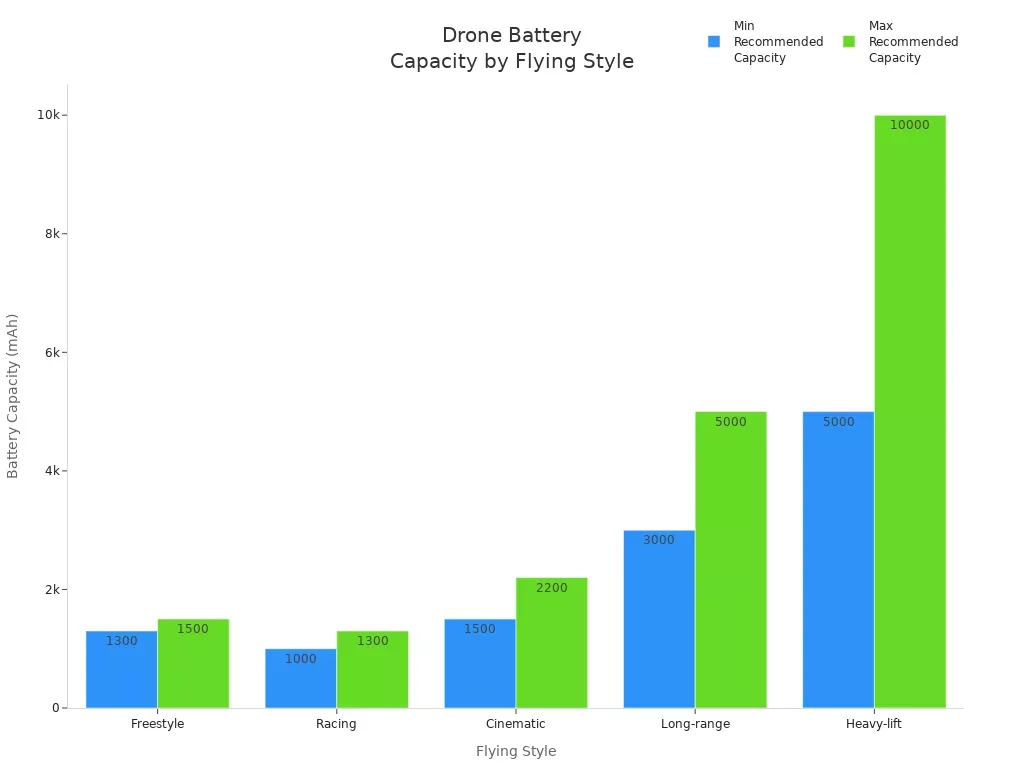
If you fly for endurance, Li-ion keeps you in the air for more minutes. Racing drones need LiPo for fast moves, but flight time is just minutes. For casual flying, pick a battery that fits your drone and gives you enough minutes in the sky. Here's a chart showing battery specs for different flying styles:
Want your battery to last more minutes? Try these tips:
Use approved chargers.
Avoid fast charging.
Charge at room temperature.
Store at 40–60% charge.
Check battery condition before flights.
Let batteries cool before recharging.
Set return-to-home for safe landings.
Think about your flying style and how many minutes you want in the air. Choose the battery that matches your needs and follow these tips for longer battery life.
You will notice Li-ion batteries last longer, while LiPo batteries give more high-current power. This battery chemistry comparison helps you pick the right one for your uav. Li-ion works best for long flights. LiPo is great for racing or tricks.
You can use Li-ion batteries in many uav models, but always check your drone's manual first. Some uav need high-current power, which LiPo batteries provide better. Make sure your uav supports the battery type before you fly.
Racing uav pilots love LiPo batteries because they deliver quick bursts of high-current power. These batteries help your uav accelerate fast and handle sharp turns. If you want speed and agility, LiPo batteries are the top choice for your uav.
You can make your uav battery last longer by charging it between 20% and 80%. Store your uav battery in a cool, dry place. Avoid draining it all the way. Always check your uav battery for damage before each flight.
RC battery chemistry tells you what materials make up your uav battery. Different chemistries, like Li-ion or LiPo, affect how your uav performs. Knowing about rc battery chemistry helps you choose the best battery for your uav's needs.