
Views: 0 Author: Site Editor Publish Time: 2026-03-16 Origin: Site
Drone payload refers to the useful weight a drone can safely carry in addition to its core flight components. In most cases, payload includes items such as cameras, sensors, LiDAR units, delivery packages, spraying systems, or other mission-specific tools.
Understanding drone payload is important because payload affects flight time, battery consumption, stability, safety, and overall mission capability. Once you understand payload clearly, it becomes much easier to choose the right drone, battery, and application setup.
If your project already involves mission-oriented aircraft and battery selection, read our article: How to Choose Batteries for a Professional Drone.
Drone payload means how much weight a drone can carry safely. This includes things like cameras, sensors, or packages.
You should always check your drone's payload capacity before you fly. This helps keep the flight safe and makes the drone work well.
If you go over the payload limit, the drone may not fly as long. It can also become unstable and might crash.
Not all drones can carry the same amount of weight. Pick a drone that fits what you need it to do.
Think about things like weight, balance, and if the payload works with your drone when you choose what to carry.
When you hear the term drone payload, you should think about anything a drone carries to do a special job. This can be a camera for taking pictures, a sensor for measuring air quality, or even a package for delivery. Industry standards say that drone payload includes any item or device mounted on a drone to perform a specific task. This does not include the drone's motor, battery, or frame. These parts help the drone fly, but they are not part of the payload.
You can find many types of payloads. Some drones carry high-resolution cameras for photography. Others use LiDAR systems to scan the ground. In farming, drones might carry sprayers to help crops grow. Each payload changes what the drone can do. The right payload lets you complete your mission, whether you want to take photos, map land, or deliver goods.
Tip: Always check what kind of payload your drone can carry before you fly. This helps you avoid problems and keeps your drone safe.
You might wonder how payload is different from the total weight of a drone. Here is a simple way to understand the difference:
Payload is the extra weight a drone can carry. This means anything added to the drone, like a camera or a sensor.
Total drone weight includes everything: the drone itself, the battery, the payload, and any accessories.
Knowing the difference helps you fly safely. It affects how long your drone can stay in the air and how well it can move.
This distinction also matters for following rules. For example, the FAA has rules about drone weight for registration.
If you add too much payload, your drone may not fly well. It could lose balance or run out of battery quickly. You need to know your drone's payload capacity to avoid these problems.
Here is a table showing how payload capacity can change with different drone models:
Model | Payload Capacity | Max Flight Time |
|---|---|---|
Draganfly Heavy Lift Drone | 67 lbs / 30 kg | 55 minutes |
Hercules 20 | 33 lbs / 15 kg | 40 minutes |
Perimeter 8 UAV | 22 lbs / 10 kg | 5+ hours |
IF1200 | 19.1 lbs / 8.6 kg | 43 minutes |
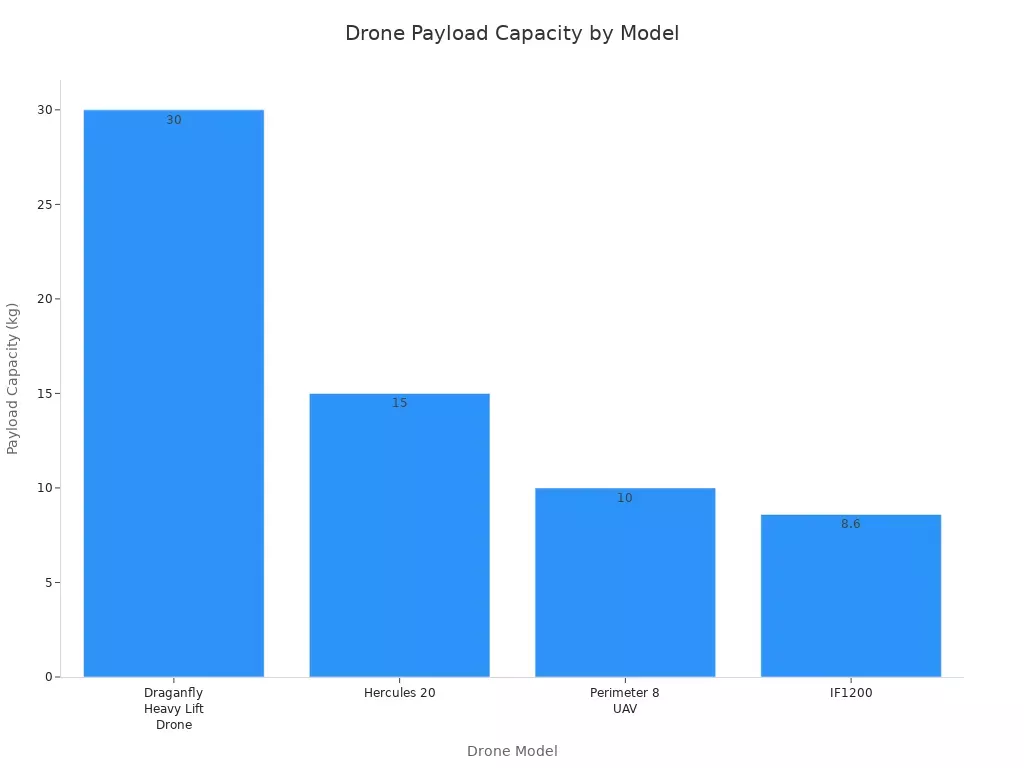
You can see that each drone has a different payload capacity. Some drones can carry only a small camera. Others can lift heavy equipment for hours. Consumer drones usually carry between 0.4 and 4.4 pounds. Commercial drones can carry much more, sometimes up to 66 pounds. Heavy-lift drones can handle even bigger loads, sometimes over 200 pounds.
When you choose a drone, always think about what you need it to carry. Matching the right payload to your drone helps you get the best results and keeps your flights safe.
It is important to know how drone payload changes flight. When you add more payload, the drone must work harder. This can make the drone fly slower. It may not go as far. The drone can also be harder to control. Look at the table below to see what happens when you add more payload:
Aspect | Effect of Increased Payload |
|---|---|
Speed | Reduced due to increased weight and drag |
Range | Decreased as more power is consumed |
Maneuverability | Compromised stability and control |
Power Consumption | Increased, leading to potential technical failures |
Stability | Affected negatively, making flight more challenging |
If you carry a heavy payload, the drone slows down. It uses more battery power. The drone might be harder to steer. Always check your payload capacity before flying. This helps you avoid problems and keeps your drone safe.
Safety is very important when flying a drone. Payload weight can make flying riskier. You need to think about the weather and other things outside. For example:
Air temperature, wind, and rain can make flying harder.
Manufacturers set safe limits for payload and weather. If you go over these limits, accidents can happen.
In one case, bad weather made a drone land quickly. This shows why you should follow the rules.
You should always follow the rules for payload and weather. This keeps your drone and equipment safe.
Tip: Check the weather and your drone's payload capacity before every flight. This helps you avoid emergencies.
You can see why drone payload matters in real missions. Here are some examples:
Search and rescue teams use drones with cameras to find people.
After disasters, drones with cameras and LiDAR help check damage fast.
Medical and supply drones carry food and medicine to hard-to-reach places.
Communication drones use special payloads to fix signals when networks go down.
Picking the right payload helps your drone do its job well. You need to match the payload to your task and your drone's abilities.
You need to know what limits how much your drone can carry. Many technical parts work together to set the drone payload capacity. Each part of the drone helps decide how much payload you can lift and fly safely. Here is a table that shows the main factors:
Factor | Description |
|---|---|
Structural design | The size and shape of the frame, along with the material, influence how much weight a drone can carry. |
Motor configuration | More motors improve load distribution, allowing for heavier cargo lifting. |
Thrust | Higher thrust from rotor size and body configuration increases payload capacity. |
Power system | Larger batteries provide more lifting power and longer flight times. |
Frame Size & Strength | A drone's frame must support its weight; carbon fiber frames are optimal for heavy loads. |
Motor Power & Efficiency | Motors determine lifting capacity; low-KV, high-torque motors with large propellers are most effective. |
Battery Capacity & Voltage | Heavier batteries reduce payload; higher voltage systems improve efficiency and thrust. |
Propeller Size & Aerodynamics | Larger, low-pitch propellers generate more lift; aerodynamic designs reduce drag. |
Motor thrust, propeller size, battery power, and frame design all affect drone payload capacity. If you want to carry more, you need a strong frame. You also need powerful motors and the right propellers. A bigger battery helps, but it adds weight. You must balance all these parts to get the best drone payload capacity.
Not all drones can carry the same amount. Consumer drones and commercial drones do different jobs. Consumer drones carry less weight. Commercial drones can lift much more. Here is a table that shows the differences:
Drone Category | Max Payload | Example Models | Typical Use Cases |
|---|---|---|---|
Consumer | 1–5 lbs. (0.5–2.2 kg) | DJI Mavic 3, Autel EVO II | Aerial photography, basic sensors |
Commercial | 20–66 lbs. (9–30 kg) | Alta X, DJI Agras T50, XAG V40 | Spraying, LiDAR, cinema, delivery |
Consumer drones can carry a small camera or a simple sensor. These drones are good for photos and videos. If you need to spray crops or deliver packages, you need a commercial drone. Commercial drones have a much higher drone payload capacity. Some heavy-lift drones can carry even more, but they cost more and need special training.
Tip: Always check your drone's manual for the exact drone payload capacity. Never guess or overload your drone.
If you want to see how payload becomes especially important in geospatial and field-data missions, read our blog: Drone Mapping vs. Drone Surveying.
Trying to carry too much is dangerous. Going over the drone payload capacity can cause problems:
Carrying too much weight makes flight time shorter and can make the drone unstable.
Overloading makes the flight controller work harder. This uses more energy and can shorten battery life.
Bad weight balance can make the drone unstable. This makes it hard to control, especially in wind or sudden moves.
If you go over the drone payload capacity, your drone might crash or stop working in the air. You could lose your equipment or cause an accident. Always follow the limits set by the manufacturer. This keeps your drone safe and helps you finish your mission.
Note: You protect your drone and your payload when you stay within the safe drone payload capacity.
There are many kinds of drone payloads. People use them for work and fun. Each payload helps the drone do a special job. Here are some common types and how you can use them.
Cameras are very popular as drone payloads. You can use visual cameras to take photos and videos. Some drones have thermal cameras for search and rescue. New camera systems mix RGB and thermal sensors. This lets you collect different data at once. Always check the camera's weight and power needs. Heavy cameras can make your drone less stable and shorten flight time.
Tip: Pick a camera that fits your mission and your drone's payload limit.
Sensors are also used often as payloads. Multispectral sensors help with farming. LiDAR scanners are good for mapping land. Ultrasonic sensors can inspect bridges. Inspection payloads help you check buildings and find problems early. Some drones carry radiation sensors to check safety at nuclear sites. Choose sensors that match your drone and your job.
Delivery packages are becoming more common. Drones can carry medical supplies, food, or other cargo. Small delivery drones carry light items far away. Bigger drones can lift heavy packages, sometimes up to 66 pounds. Secure compartments and release systems help deliver items safely.
Delivery drones usually carry 2.2 to 66 pounds.
Medical drones deliver light and urgent items.
Logistics drones move bigger loads for businesses.
Specialized tools help drones do more tasks. Manipulator arms can move debris or handle materials in risky places. Floodlights and loudspeakers help during emergencies. Some drones carry communication equipment to fix signals in remote areas. Custom payloads include crop sprayers for farms or LPS testing tools for wind turbines. These payloads help solve special problems and support important missions.
Payload Type | Specific Use |
|---|---|
LPS Testing Tools | Check wind turbines quickly |
Radiation Sensors | Measure radiation in unsafe places |
Communication Equipment | Extend networks in far locations |
Public Safety Tools | Give light and alerts in emergencies |
You can change drone payloads to fit your needs. This makes drones helpful in many jobs.
Picking the right payload helps your drone do its job well. You need to think about your goal, how much weight your drone can carry, and if everything fits together.
First, ask what you want your drone to do. Each mission needs a different payload. Mapping jobs use cameras with grid planning. Search and rescue teams need thermal sensors and live video. Farming missions use multispectral sensors. The table below shows which payload features work best for each mission:
Mission Type | Recommended Features | Why It Works |
|---|---|---|
2D Mapping / Surveying | Grid planning, overlap control | Complete image coverage for accurate mapping |
Inspection | Waypoints, gimbal angle control | Precise control over inspection areas |
Search & Rescue | Thermal payload, live rerouting | Fast response in emergencies |
Agricultural Monitoring | Multispectral sync, terrain-following | Better crop health data |
Disaster Response | Rapid map processing, short takeoff time | Quick action in low-connectivity areas |
Always match the payload to your mission goals.
Check the payload weight before you fly. Too much weight can make your drone lose flight time or become unstable. Keep the center of gravity near the middle of the drone. This helps the motors work better and keeps your flight smooth. If the payload hangs too low, it causes drag and makes the drone harder to control. Good balance means safer flights and longer battery life.
Make sure your payload fits your drone. Sometimes, new payloads do not fit or need special software. You might find few instructions or problems with the drone's controls. Always check if your drone supports the payload you want to use. Look for updates or help from the manufacturer.
You must follow all rules for drone payloads. Check local and international laws about weight limits and flight zones. Never fly with a payload that breaks these rules. Safety comes first. Always test your setup before a real mission.
If you are comparing larger FPV platforms where frame size changes payload ability quite a lot, read 10 Inch FPV vs 13 Inch FPV vs 15 Inch FPV.
Drone payload is one of the key factors that determines how useful, safe, and efficient a drone can be in the real world. Payload affects battery life, stability, power demand, and mission success.
If you understand payload properly, you will make better choices about aircraft size, battery direction, and mission planning. That becomes even more important when the drone is being used for professional work, heavier sensors, or longer flights.
If you need help choosing the right battery direction for a payload-heavy drone project, contact us for technical support.
Payload means the extra items you add to your drone, like cameras or sensors. Total drone weight includes the drone itself, the battery, and the payload. You need to know both for safe flying.
You can check your drone's manual or the manufacturer's website. Look for "maximum payload" or "payload capacity." Never guess. Always use the official number to keep your drone safe.
Your drone may lose control, fly for less time, or even crash. You could damage your drone or lose your equipment. Always stay within the payload limit.
You can sometimes upgrade motors or batteries, but this is not always safe. You should ask the manufacturer before making changes. Upgrades may void your warranty or break safety rules.
A heavier payload makes the motors work harder. This uses more battery power. Your drone will fly for a shorter time. Always plan your flight based on the payload you carry.