
Views: 0 Author: Site Editor Publish Time: 2026-04-30 Origin: Site
You want to know how many times you can use your ternary lithium battery before it needs to be replaced. The theoretical life of a ternary lithium battery is about 800 cycles. Manufacturers usually promise more than 500 cycles under normal use. If you charge and discharge the battery only a little, you can make it last at least 1000 cycles. In tough conditions, the battery cycle life falls below 200 cycles. Knowing the cycle life of a lithium-ion rechargeable battery helps you guess how long it will last and when to replace it. You can also compare battery life with other lithium-ion battery types:
Battery Type | Cycle Life (Cycles) | Lifespan (Years) |
|---|---|---|
Lithium Iron Phosphate (LiFePO4) | 3,500+ | ~10 |
Ternary Lithium | 1,000 | ~3 |
Knowing how long a battery lasts helps you choose the right rechargeable battery for your needs.
Ternary lithium batteries can last 1,000 to 2,000 cycles. How long they last depends on how you use and charge them.
Keep your battery charged between 40% and 80%. This helps the battery last longer and lowers stress.
Do not let your battery drop to 0% often. Do not charge it to 100% all the time. This can make the battery not last as long.
Store your battery in a cool and dry place. Check its charge every three months to keep it healthy.
Hot temperatures can hurt your battery. Always charge it in the right temperature range.
When you look for strong batteries, you may hear about ternary lithium batteries. Ternary lithium battery is a kind of lithium-ion rechargeable battery, and it refers to a lithium secondary battery that uses nickel, cobalt, and manganese as their main metals. Each metal helps the battery work better in a different way. Nickel lets the battery hold more energy. Cobalt keeps the battery steady and safe. Manganese makes the battery safer and costs less money. You can see what each metal does in the table below:
Metal | Primary Function | Performance Contribution |
|---|---|---|
Nickel | Energy storage | Increases capacity and energy density |
Cobalt | Structural stabilizer | Improves cycle life and conductivity |
Manganese | Safety enhancer | Reduces thermal risk and lowers cost |
Ternary lithium batteries are special because they have a high discharge voltage of 3.7V. This is higher than other batteries like lithium iron phosphate or lithium titanate. You get more energy from a smaller and lighter battery. The mix of metals gives these batteries a good balance of power and safety. There are two main types: NMC and NCA. NMC stands for nickel, manganese, and cobalt. NCA stands for nickel, cobalt, and aluminum. NMC batteries last longer and work well for many uses. NCA batteries can store even more energy, which is great for electric cars.
Tip: If you want a battery that lasts long and stores lots of power, ternary lithium batteries are a good pick.
You can find ternary lithium batteries in many things. They are used in electronics because they hold a lot of energy. Phones, laptops, tablets, and smartwatches use these batteries. This helps your devices last longer and weigh less. Electric cars also use ternary lithium batteries for long trips and strong power. Companies like Tesla, BMW, and Mercedes-Benz use these batteries in their cars.
Consumer electronics: Smartphones, laptops, tablets, and wearables
Electric vehicles: Tesla, BMW, Mercedes-Benz, Nissan
Energy storage systems: Store renewable energy for homes and businesses
Medical devices: Power portable equipment like infusion pumps and defibrillators
Drones and robotics: Provide high power output and compact design
Power tools: Deliver quick bursts of energy for demanding tasks
Ternary lithium batteries are also used to store energy from the sun or wind. This helps people use solar or wind power even when the weather changes. Medical tools use these batteries because they are light and work well. Drones and robots need small batteries with lots of power, so these batteries are a good fit. Power tools use them for fast and strong energy.
Many rechargeable lithium batteries use ternary materials. This helps new technology work better, from electric cars to smart gadgets. When you pick a lithium battery, you get good energy, safety, and dependability.
You might hear people talk about a "charge cycle" when they discuss lithium-ion batteries. A charge cycle happens when you use all the battery’s energy and then fill it up again. For example, if you use half your battery today and charge it, then use the other half tomorrow and charge it again, that counts as one cycle. This helps you know how long your battery will work.
A charge cycle is important because it tells you how many times you can use and recharge your battery before it starts to get weaker. Most companies use cycles to measure battery life. When a battery reaches a certain number of cycles, it cannot hold as much energy as before. For ternary lithium batteries, the cycle life ends when the battery can only hold 70% of its first charge.
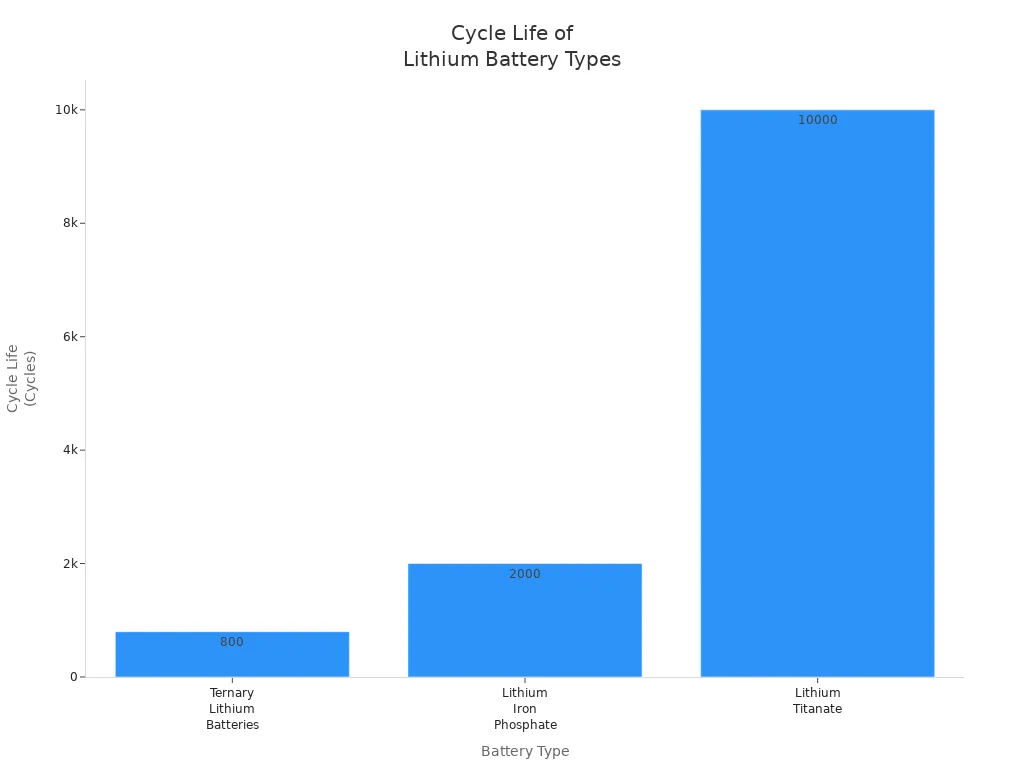
Here is a table that shows how different batteries compare:
Battery Type | Cycle Life (Cycles) | Capacity Drop Threshold |
|---|---|---|
Ternary Lithium Batteries | ~800 | 70% of nominal value |
Lithium Iron Phosphate | ~2000 | 70% of nominal value |
Lithium Titanate | ~10000 | 70% of nominal value |
You can see that ternary lithium batteries do not last as long as some other types. This means you should watch how you use and charge your battery.
Charging cycles are a big part of how long your battery lasts. Every time you use up and recharge your battery, you finish one cycle. Over time, the number of cycles goes up. The more cycles you use, the shorter your battery life gets.
Recent studies show that regular NCM ternary lithium batteries can last between 1,500 and 2,000 cycles if you take good care of them. High-nickel models do not last as long. They have about 20% to 30% fewer cycles than NCM types. If you use fast charging, the cycle life can drop to about 800 cycles. The Fraunhofer Institute found that NCM622 batteries with 2C fast charging reach about 800 cycles.
Battery Type | Typical Cycle Life (cycles) | Notes on Conditions |
|---|---|---|
Ordinary NCM Ternary Lithium | 1,500-2,000 | Based on domestic tests by the Institute of Mechanics, Chinese Academy of Sciences |
High-Nickel Models | ~20%-30% lower than NCM | Reduced stability leads to shorter life |
NCM622 under 2C Fast Charging | ~800 | Fraunhofer Institute study (2024) |
You might wonder how people measure cycle life. Scientists test batteries by charging and using them until the battery can only hold 70% of its starting energy. This is when the battery is not very useful anymore. In real life, after about 1,000 cycles, a ternary lithium battery may lose half its power. This means your phone or car will not last as long on one charge.
How you use your battery also changes how many cycles you get. If you always use up your battery all the way and then charge it to full, you use cycles faster. This is called a full cycle. If you only use part of the battery and charge it, you use partial cycles. Partial cycles are better for battery life. For example, keeping your battery between 40% and 80% can help it last longer.
Here is a table that shows how different charging habits affect battery life:
Cycle Type | Impact on Longevity |
|---|---|
Full Cycle | Compromises cycle life of lithium-ion batteries |
Partial Cycle | Prolongs battery life by reducing stress |
Low DoD | Increases battery lifespan |
Charge Level | 50% SOC increases lifetime expectancy by 44–130% |
If you use shallow discharges, like charging your battery when it is half empty, you can get more cycles. Some tests show that charging only part of the battery can give you 900 to 1,500 cycles. This means you can use your battery for a longer time before you need to buy a new one.
Tip: Try not to let your battery go all the way to zero or charge it to 100% every time. Keeping your battery in the middle range helps it last longer.
You can help your batteries last longer by changing how you charge them. The way you charge affects how healthy the battery stays. If you use the 40–80 rule, your battery will stay strong. This means you keep the battery between 40% and 80% charged. You should not let it get too empty or too full. Doing this helps your battery last longer.
Charging all the way to 100% or letting it drop to 0% is bad. It puts stress on the battery and makes it wear out faster. Using only part of the battery before charging is better. This is called partial charging. It helps you get more cycles from your battery. Shallow charging is good because it keeps the battery safe. It stops harsh changes inside the battery that can break it.
Here is a table that shows how different charging habits affect battery life:
Charging Habit | Impact on Cycle Life |
|---|---|
Deep Discharge | Makes the battery age faster; do not let it go below 40%. |
Partial Charging | Charging to 70%-80% often helps the battery last longer. |
Deep Charging | Causes strong reactions inside; doing this a lot makes the battery age faster. |
Shallow Charging | Keeps reactions gentle; helps the battery last longer by not going too low or too high. |
You can follow these tips to help your battery last:
Keep the battery between 20% and 80% charged.
Use special charging methods like Constant Current–Constant Voltage with Negative Pulse.
Always follow the instructions from the company that made your battery.
Tip: Keeping your battery between 20% and 80% helps it last longer. Try not to let it go all the way empty or full.
Many studies show that good charging habits slow down battery aging. If you use fast charging a lot, you might worry about hurting your battery. Research says fast charging does not make a big difference in the short term. Electric cars have systems that protect the battery when charging fast. But if you do not use good habits, fast charging can still hurt the battery over time.
Temperature is very important for battery health. Charging or using your battery at the right temperature helps it last longer. Hot weather can make the battery work better for a short time. But it also makes the battery age faster. When it is hot, bad reactions happen inside the battery. This makes it lose power faster.
Studies show that batteries wear out much faster when it is hot. At room temperature, the battery loses power slowly. When it is hot, it loses power much faster. This means your battery will not last as long if it gets too hot.
Cold weather is also bad for batteries. When it is cold, the battery works slowly. The battery can lose power and not work as well. Tests show that in very cold weather, the battery can get damaged inside. This can cause short circuits and make the battery not last as long.
Here is a table showing the best temperatures for charging and using ternary lithium batteries:
Temperature Condition | Recommended Range | Effects |
|---|---|---|
Charging | 5℃ to 35℃ | Best for battery health and stops it from aging fast |
Too High | >40℃ | Makes the battery age faster and can be unsafe |
Too Low | <0℃ | Makes charging harder and battery may not work right |
Note: Always charge and use your battery at the right temperature. Too hot or too cold can make your battery lose power and not last as long.
How you use and store your battery changes how long it lasts. If you use all the battery each time, it will wear out faster. Using only part of the battery before charging helps it last longer.
Here is a table showing how using different amounts of the battery changes how long it lasts:
Depth of discharge | Ternary lithium battery cycle number | Lithium iron phosphate battery cycle number |
|---|---|---|
20% DOD | more than 5000 times | more than 8000 times |
80% DOD | 1000 times | 2000 times |
100% DOD | 300 times | 500 times |
Using all the battery each time makes it age faster and lose power.
It also makes the battery get hotter and not work as well.
Doing this a lot makes the battery not last very long.
How you store your battery is important too. If you keep your battery somewhere hot, it will wear out faster. The battery will lose power and not work as well. Bad things can happen inside the battery that you cannot fix.
Tip: Store your battery in a cool, dry place. Keep it charged between 40% and 60% if you will not use it for a long time. This helps your battery stay healthy.
You can keep your battery working well by following these easy steps. Do not use all the battery each time. Charge it at the right temperature. Store it the right way. These habits help your battery last longer and work better.
If you want your ternary lithium battery to last, use the 40-80 rule. Keep the battery charged between 40% and 80%. Do not charge it all the way or let it get empty. This puts less stress on the battery and helps it last longer. Charging between 80% and 90% is also good for the battery. Try not to let the battery go below 20% before you charge it again. Charge your battery when the temperature is between 50°F and 95°F. This keeps the battery healthy and stops damage. If you keep the charging voltage around 4.10V for each cell, the battery can last twice as long. Do not use fast charging too much, especially when it is hot. Fast charging in heat can wear out the battery faster.
Tip: Plug in your battery before it gets too low. Unplug it before it reaches 100%. This easy habit can make your battery last hundreds of cycles longer.
If you need to store your battery, keep it charged between 40% and 60%. This helps stop chemical damage and keeps the battery safe. Check your battery every three months. If the charge drops below 20%, charge it back up to 40%-60%. Store your battery in a cool, dry place. The best temperature is between 59°F and 77°F. Do not put your battery in places that are wet or in the sun. Good airflow helps keep the battery dry and safe.
Storage Parameter | Recommendation |
|---|---|
State of Charge (SOC) | Store at 40%-60% charge to keep the battery stable |
Temperature | Keep between 15°C and 25°C (59°F to 77°F) |
Humidity | Store in dry places; do not let humidity go over 50% |
Maintenance | Check the charge every 3 months; recharge if it goes below 20% |
Stress makes batteries wear out faster and can be unsafe. Hot weather makes batteries age quickly and can cause fires. Dropping or hitting the battery can break it inside and make it weak. Many devices have systems that watch the battery’s temperature and charging speed. These systems warn you if something is wrong so you can fix it. To keep your battery safe, keep it cool and do not drop it. Try not to use all the battery before charging. Using only part of the battery is better. The 40-80 rule helps you avoid high voltage and heat. This can make your battery last two or three times longer.
Remember: Be gentle with your battery. Do not let it get too hot, hit it, or use all its power. This will help your battery work well and stay safe.
You can use a ternary lithium battery for 1,000 to 2,000 cycles. How you charge, use, and store it matters a lot.
To make your battery last longer:
Keep the charge range small.
Do not let it get hot when fully charged.
Use lower charge voltages, like 4.10V per cell.
These steps help your battery stay strong and safe.
You should get a new battery if it holds less than 70% of its first charge. If your device loses power fast or turns off without warning, the battery is likely at the end of its life cycle.
Fast charging can make the battery not last as long if you use it a lot, especially when it is hot. Try not to use fast charging too much and do not charge in high heat to help your battery last longer.
Charging to 100% all the time puts stress on the battery and makes it wear out faster. It is better to keep your battery between 40% and 80% charged to help it last longer and work better.
Hot weather makes the battery age faster and lose power. Cold weather makes the battery work slower and can hurt it. Always charge and use your battery between 5℃ and 35℃ for the best results.
Tip: Keep your battery in a cool, dry place and stay away from very hot or cold spots to help it work well.