
Views: 0 Author: Site Editor Publish Time: 2026-04-16 Origin: Site
You may see that your battery devices do not last as long when it is cold. Low temperature slows the chemical reactions inside a battery. It makes it harder for energy to move. This causes less power and shorter use time.
When it gets cold, the chemical reactions in a battery slow down. Cold weather makes the battery's resistance go up. This makes it harder for the current to move. Because of this, batteries can have less capacity and give less power.
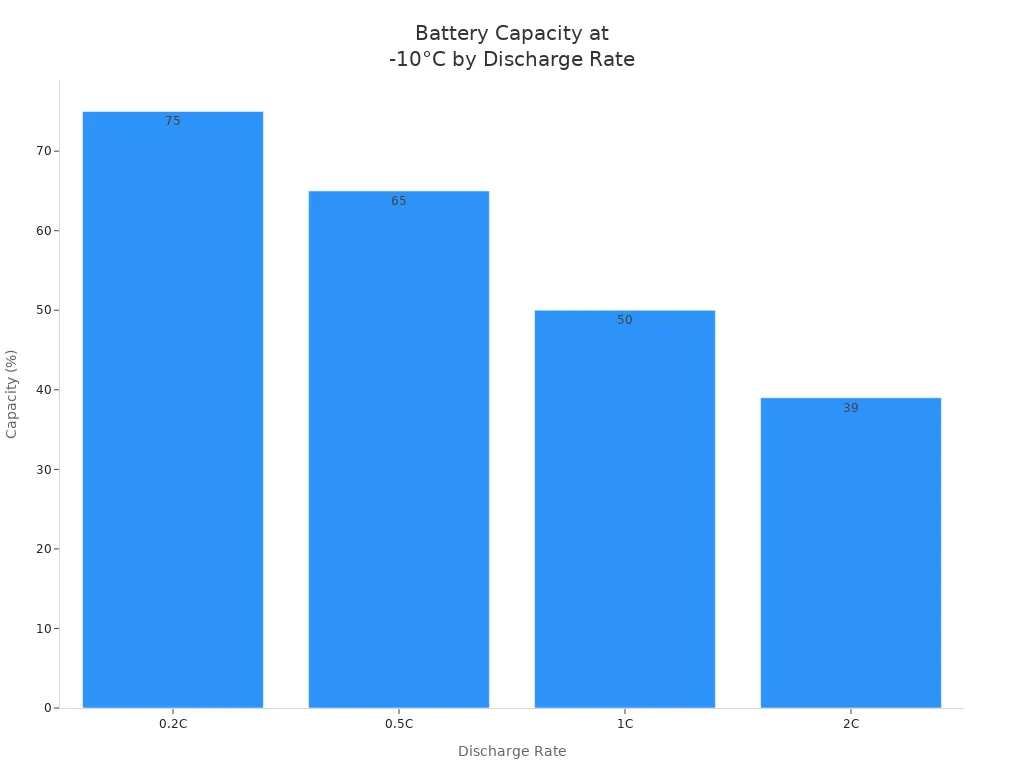
Low temperature battery performance is important for your safety and comfort, especially in winter.
Cold weather makes batteries weaker and less powerful. At 0°C, batteries might lose as much as 30% of their power.
Do not charge batteries when they are cold. Charging in cold weather can hurt them forever.
Keep batteries warm so they work better. Put devices in a warm spot to help them last longer in the cold.
You might see your phone or flashlight run out faster in the cold. This is because cold slows down the chemical reactions inside the battery. When it gets colder, the battery cannot hold as much energy. The table below shows how much battery power drops as it gets colder:
Temperature | Approx. Capacity Retained |
|---|---|
25°C (77°F) — Room temp | ~100% (baseline) |
0°C (32°F) — Freezing | ~70–80% |
-10°C (14°F) | ~60–70% |
-20°C (-4°F) | ~50–60% |
-30°C (-22°F) | ~40–50% (with high risk of damage) |
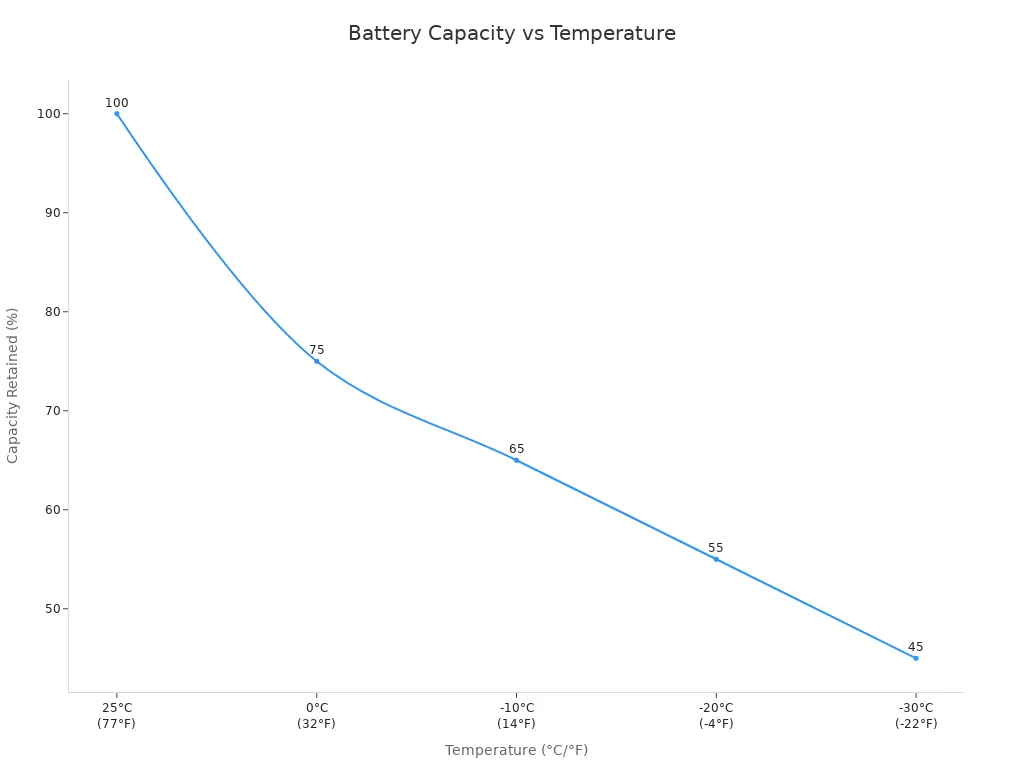
When you use devices in the cold, they do not last as long. Your camera might turn off sooner, or your flashlight may look dim. Your phone battery can also die much quicker in cold weather. This drop in power makes it hard to trust your devices outside.
Cold does more than just lower battery power. It also makes battery resistance go up. In cold weather, the inside of the battery gets thick and sticky. This makes it hard for ions to move around. The table below explains why this happens:
Mechanism | Explanation |
|---|---|
Temperature Effects | Chemical reactions slow down a lot when it gets cold, so batteries work worse. |
Increased Viscosity | Cold makes the inside liquid thicker, so ions move slower. |
Reduced Ion Mobility | Ions move slowly in the cold, so the battery works less well. |
Diffusion Limitations | Cold slows down how things spread inside, so less stuff gets to where it is needed. |
Activation Energy Barriers | Cold makes it harder for reactions to start, so the battery slows down. |
Internal Resistance Increase | Cold can make resistance much higher, so less energy comes out. |
Performance Decline | Batteries work much worse in the cold, with only about 25% power at -22°F (-30°C). |
You might see your devices work slowly or not charge well in the cold. This is because the battery cannot move energy easily. The resistance goes up, and reactions slow down. Your device might not turn on, or it could shut off fast.
Tip: Battery management systems help keep batteries safe. They watch the temperature and change charging to stop damage in the cold.
Cold can also make batteries unsafe. Charging a lithium-ion battery when it is freezing can ruin it forever. This is because something called lithium plating can form inside, which can cause short circuits or fires. Never charge your phone or laptop if it feels very cold.
Here are some problems you might have in the cold:
Batteries run out faster and might not charge.
Devices like phones and cameras can turn off without warning.
LCD screens can freeze or react slowly.
If you bring a cold device into a warm room, water can form inside and hurt the battery.
Manufacturers make special changes to help batteries work better in the cold. They add chemicals to stop the inside from freezing. Some batteries have heaters or insulation to stay warm. These changes help batteries stay safe and last longer in cold weather.
Note: Always keep batteries in a cool, dry place above freezing. If you will not use lithium-ion batteries for a while, keep them at 30% to 50% charge.
You can help your devices by keeping them warm and not charging them when it is freezing. This helps your battery last longer and work better, even when it is cold outside.
When it gets cold, your car battery has a hard time starting the engine. Cold slows down the chemical reactions inside the battery. This makes it tough for the battery to change chemical energy into electrical energy. The electrolyte inside gets thick, so ions move slower and resistance goes up. Because of this, cranking power drops.
At 32°F, your car battery can lose about 35% of its strength.
At 0°F, the loss increases to 60%.
The battery capacity drops by 20% at 32°F and even more as temperatures fall.
Cold weather makes the battery's resistance higher. The electrolyte does not carry electricity as well, so the battery works worse. The battery cannot give enough power to start the car, so the engine might not start. You might hear the starter motor turn slowly or not at all.
Cold weather is hard on your car battery. The battery loses about 35% of its power at 32°F and up to 60% at 0°F. This makes it harder to get enough power to start the car.
It can be hard to start your car because the battery gives less cranking power. The chemical reactions slow down, so the battery cannot make enough electricity. The engine needs more power to start in the cold, but the battery cannot keep up.
Ions in the battery move slower, so the battery works worse.
Charging takes longer and the battery holds less power in the cold.
The electrolyte gets thicker, so ions cannot move well.
This means the battery cannot give its best power, so you get less power and capacity.
You might see your car take longer to start or not start at all. Charging does not work as well, and it takes longer to recharge. The battery cannot get back to full power quickly after you use it. If you drive an electric car, you might lose 20 to 40% of your driving range when it is cold.
Factor | Electric Vehicle Batteries | Internal Combustion Engine Vehicles |
|---|---|---|
Performance in Cold Weather | Poor performance due to low temperatures affecting battery chemistry | Better performance, can start reliably due to energy conversion processes |
Current Supply Requirement | Requires continuous current supply | Requires short peak current to start the engine |
Impact of Temperature | Increased ohmic losses and lower cell voltage | Thicker lubricating oil affects performance |
You can do things to help your car battery work better in the cold. Simple checks and care can make your battery last longer and help your car start.
Spray battery terminals with protectant to stop rust.
Tighten the battery so it does not move around.
Check and replace broken hold-down parts.
Keep the battery charged with a maintainer or trickle charger.
Turn off things like the radio before starting the car.
Park in a garage to keep the battery warmer.
Check and change the battery if it is old or weak.
Use a battery blanket to keep the battery warm in very cold weather.
Let the engine run for a short time before driving to help the battery.
Make sure the battery is held down tight to stop damage.
You should also do these things:
Look at the battery often for rust and loose wires.
Clean the battery with baking soda and water.
Check the battery fluid and add distilled water if needed.
Take longer trips instead of many short ones to charge the battery.
Buy a battery blanket to keep the battery warm.
Use a charger to keep the battery full when you are not driving.
Park inside if you can to keep the battery out of the cold.
Tip: Turn off your headlights, radio, and heater before you start the car. This helps the battery give all its power to start the engine.
Doing these things helps your car battery last longer and keeps cranking power strong. Good care means your car starts better and the battery works well, even when it is cold.
Lithium-ion batteries are in things like phones and cars. They work best when it is not too hot or cold. When it gets cold, these batteries lose power fast. At 0°C, you can lose about 20–30% of the battery's power. At -10°C, you only get about 70% of normal power. At -20°C, you might lose half the battery's power. If you try to charge them below freezing, it can hurt the battery. They will not charge if it is colder than 32°F, so do not charge them when it is very cold.
Temperature | Available Capacity |
|---|---|
25°C | 100% |
10°C | 90–95% |
0°C | 75–85% |
-10°C | 60–70% |
-20°C | 45–60% |
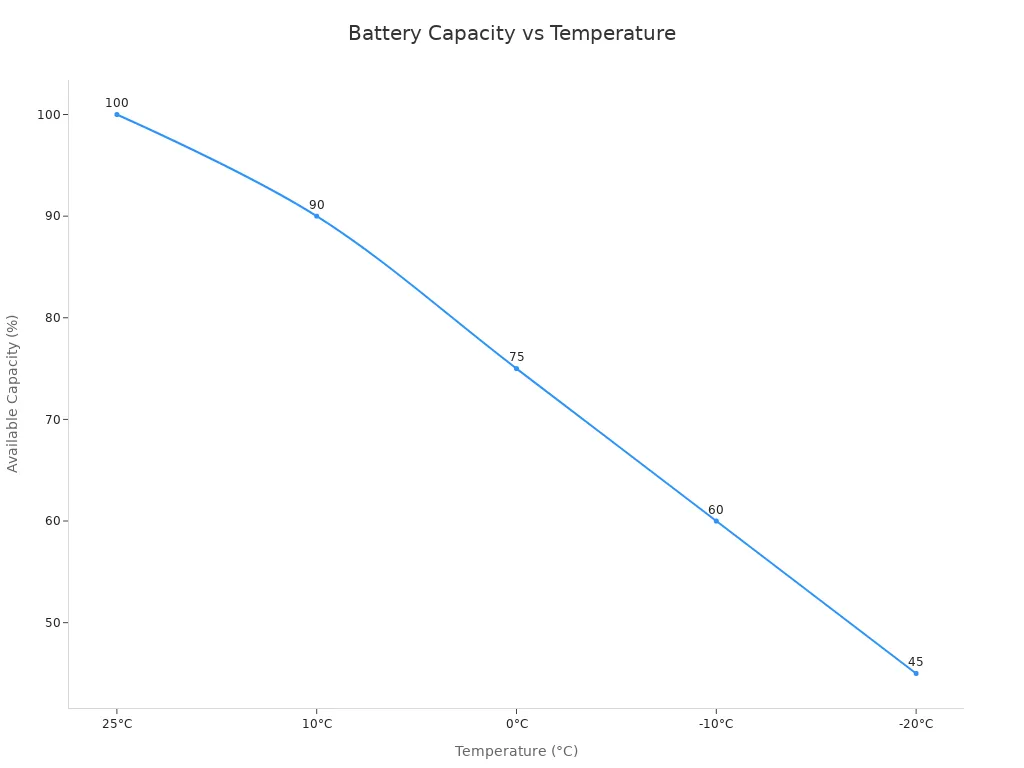
When it gets colder, the battery's resistance goes up. This makes it harder for the battery to give power.
Lead-acid batteries are used in cars and backup power. They can still charge in the cold, but they do not work as well. At 0°F, lead-acid batteries only give about 45% of their normal power. Lithium-ion batteries give about 70% at the same temperature. Lead-acid batteries can charge when it is cold, but it takes longer and they lose power.
Battery Type | Charging Temperature Range | Discharging Temperature Range | Performance in Cold Weather |
|---|---|---|---|
Lead-Acid | 0 to 45–50°C | -20 to 50°C | Can charge at low temps, but performance drops |
Lithium-ion | 0 to 45°C | -20 to 60°C | Charging below 0°C can damage the battery; performance drops at low temps |
Nickel-based batteries also lose power in the cold, but not as much as lithium-ion batteries.
When you need a battery for cold places, think about these things:
Cold cranking amps (CCA) help start cars in the cold.
Reserve capacity keeps your device on if it is hard to start.
The battery's design and materials change how it works in the cold.
Maintenance-free batteries are easier to use.
Pick a battery that fits what you need in the cold. Lithium-ion batteries have lots of energy, but lose power fast when it is cold. Lead-acid batteries are better for starting engines in the cold, but they are heavy and not as efficient. Always check the battery's temperature range and power before buying.
Cold weather makes your battery work slower and weaker. The chemical reactions slow down, so you get less power. The resistance in the battery goes up when it is cold. This can make your battery stop working or even get damaged. You should check your battery often to catch problems early. Keep your battery clean so it works better. Use the right charger to help your battery last longer. Pick a battery that works well in winter to stay safe.
You see your phone lose power quickly in cold weather because chemical reactions slow down. The battery cannot deliver energy as well when it gets cold.
You should avoid charging batteries when they feel cold. Charging in low temperatures can damage the battery and reduce its lifespan.
You can keep your battery warm by storing devices inside your jacket or bag. This helps your battery work better in cold conditions.