
Views: 0 Author: Site Editor Publish Time: 2026-04-23 Origin: Site
You must watch the maximum voltage when using a lithium-ion battery. This number is usually 4.2V. It is the highest voltage the battery can safely reach when charging. The battery's materials and electrode potential set this limit. This helps protect the battery's structure. If you go over 4.2V, there are big risks:
The battery will not last as long
The battery can swell or change shape
The battery can get damaged inside
The whole system might stop working
There could be overheating or even fires
The highest safe voltage for lithium-ion batteries is 4.2V. Going over this can hurt the battery and make it not last as long. Charging past 4.2V can make the battery too hot. It can also make the battery swell or even catch fire. Always use a charger that fits your battery's voltage. Knowing the difference between nominal voltage (about 3.6V) and maximum voltage (4.2V) helps you use batteries safely. It also helps you use them the right way. Many new devices have a battery management system, or BMS. This system stops the battery from charging too much. Make sure your device has this feature to stay safe. To make your battery last longer, only charge it up to 80%. Also, do not charge it when it is hot. This helps the battery stay healthy and stops bad things from happening.
When you use a lithium-ion battery, you need to know its maximum voltage. The number 4.2V is important. Battery makers pick this number for good reasons. The maximum voltage is the highest level the battery can reach when charging. If you charge past this number, the battery can get hurt or become unsafe.
Here is why 4.2V is the limit:
The battery's electrode materials set this voltage.
The battery's electrolyte works best in a safe range, and 4.2V is inside this range.
Charging above 4.2V can break down the electrolyte and harm the electrodes.
The open circuit voltage is set at 4.2V to keep the battery safe. This fits inside the electrolyte's range, which is about 1V to 4.5V.
The maximum voltage is not just for more power. It helps keep the battery safe and makes it last longer.
You may see two voltage numbers for a lithium-ion battery: nominal voltage and maximum voltage. These numbers are not the same. The nominal voltage is usually about 3.6V or 3.7V. This is the average voltage when the battery is being used. The maximum voltage, about 4.2V, is the highest voltage when the battery is fully charged. The battery's chemistry and how it works set these numbers.
Here is a table showing typical nominal and maximum voltages for common lithium-ion battery types:
Chemistry | Nominal Voltage | Full Charge Voltage | Discharge Cut-off Voltage |
|---|---|---|---|
LiCoO₂ (Lithium Cobalt) | 3.6V | 4.2V | 3.0V |
LiFePO₄ (Lithium Iron) | 3.2V | 3.6V | 2.5V |
LiMn₂O₄ (Lithium Manganese) | 3.7V | 4.2V | 2.5V |
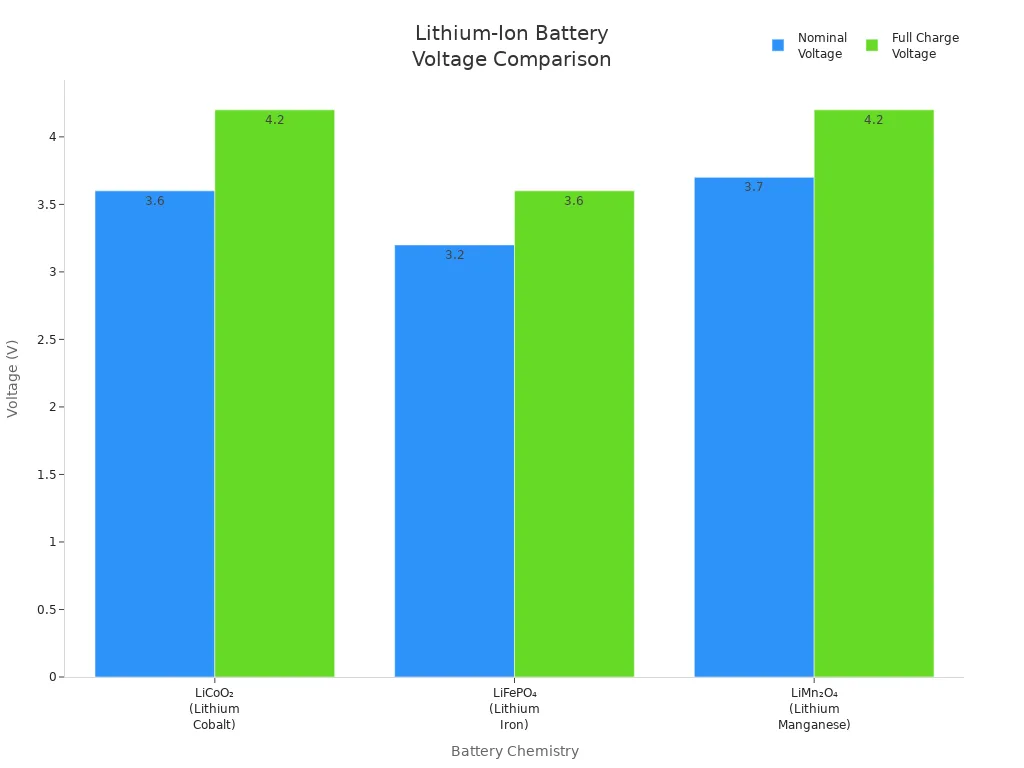
When you charge your battery, you bring it up to its maximum voltage. When you use it, the voltage drops to the nominal value. Knowing these numbers helps you use your battery safely and get the best performance.
You may wonder why a lithium-ion battery stops at 4.2V. The answer is about what is inside the battery. The anode and cathode have special chemical properties. These properties decide the highest voltage you can use safely.
The table below shows how different materials change battery performance:
Aspect | Detail |
|---|---|
Anode Material | Lithium metal gives the lowest redox potential and the highest energy, but graphite is safer for most batteries. |
Cathode Material | Lithium cobalt oxide offers high capacity, but it limits how much energy you can store. |
Voltage Influence | Adding more nickel to the cathode can boost capacity, but it also makes the battery less stable at higher voltages. |
The voltage comes from the difference between the anode and cathode. If you use other materials, the voltage will change. Most lithium-ion batteries have a rated voltage of 3.7V. When fully charged, they reach 4.2V. Some types, like lithium iron phosphate, have lower voltages. You cannot go above 4.2V because the materials will start to break down. This limit keeps your battery safe and working well.
Tip: The electrode materials decide how much energy your battery can hold and how high the voltage can go. Always check the battery type before you use it.
The solid electrolyte interface (SEI) is also important. This thin layer forms on the anode during the first charge. It protects the anode and helps the battery last longer. The SEI must stay strong at high voltages. If the voltage gets too high, the SEI can break down. This can make lithium form sharp spikes called dendrites. Dendrites can cause short circuits.
Evidence Type | Description |
|---|---|
SEI Composition | The SEI has special compounds that keep it strong and safe for battery use. |
Dendrite Growth | If the SEI is weak, lithium dendrites can grow and damage the battery. |
Electrolyte Interaction | The SEI changes with different electrolytes, which affects battery safety and performance. |
The electrolyte is a liquid or gel that lets ions move between the anode and cathode. It has a safe range called the energy gap. For most lithium-ion batteries, this gap is between 1V and 4.5V. The 4.2V limit is inside this safe range.
The electrolyte must stay stable at high voltage. If you charge above 4.2V, the electrolyte can start to break down.
When the electrolyte breaks down, it can release gases and heat. This can make the battery swell or even catch fire.
Some electrolytes are more flammable than others. If the battery gets too hot, it can explode.
You need to keep the voltage below 4.2V to avoid these problems. The stability of the electrolyte keeps you and your devices safe. Overcharging can cause thermal runaway. This means the battery heats up very fast and can become dangerous.
Note: New battery research looks at solid-state electrolytes. These can handle higher voltages and make batteries safer. You may see these in future electric cars and gadgets.
If you charge a lithium-ion battery too much, you put it in danger. Overcharging does not just make the battery die faster. It also causes changes inside the battery that cannot be fixed. Here is what happens if you go over the safe voltage:
The battery's chemical structure gets damaged and cannot heal.
The electrolyte breaks down and makes gas. This gas can make the battery puff up.
The positive electrode changes shape. It cannot hold as many lithium ions, so the battery loses power forever.
Charging too much can start thermal runaway. This is a very dangerous reaction that can cause fire or explosion.
You should always stop charging when the battery is full. If you do not, you can ruin the battery for good. The battery will not work well, and it could become unsafe.
Alert: Never try to get more energy by charging past the right voltage. This will only make your battery weaker and more dangerous.
Going over the maximum voltage does not just hurt the battery. It can also be very unsafe for you and your devices. When you overcharge a lithium-ion battery, it gets hot fast. This heat can start thermal runaway. In thermal runaway, the battery keeps getting hotter until it catches fire or explodes.
Here is a table that shows the most common dangers when you go over the safe voltage:
Hazard Type | Description |
|---|---|
Thermal Runaway | A critical failure where a lithium-ion battery overheats uncontrollably, leading to fire or explosion. |
Release of Gases | The release of flammable gases such as hydrogen and methane poses serious explosion risks in enclosed spaces. |
Overcharging also makes the battery let out gases. These gases, like hydrogen and methane, can catch fire easily. If you use the battery in a closed space, these gases can build up and explode. Even if there is no fire, the battery can swell and break open.
One of the worst things about thermal runaway is the release of these gases. They can fill a small space and make high pressure. If the pressure gets too high, the battery can burst. This can hurt you or break your device.
If you see a battery swelling, getting hot, or leaking, stop using it right away. If there is a fire, use a Class D fire extinguisher or dry sand. Do not use water or a regular fire extinguisher. If the battery's liquid gets on your skin, wash it off with water and get medical help.
Tip: Always use a charger that matches your battery's voltage rating. This easy step keeps you and your devices safe.
You may ask why the maximum charge voltage is 4.2V. This number is not picked by chance. Battery makers choose it because it fits the battery's materials. The full-charge voltage helps keep the battery safe and steady. If you charge above this voltage, the battery can get unsafe. The charge-termination voltage must stay in the safe range for the electrolyte. This stops bad reactions that could hurt the battery.
Industry standards are made to protect you. These rules tell how to test and use batteries safely. Here is a table with some important standards and what they check:
Standard | Primary Application | Common Test Requirements |
|---|---|---|
UN 38.3 | Transportation Safety | Altitude, Thermal Cycling, Vibration, Shock, Short Circuit |
IEC 62133 | Portable Product Safety | Continuous Charging, Drop Testing, Case Stress |
UL 1642 | Lithium Cell Safety | Impact, Temperature Cycling, Forced Discharge |
Most devices charge each cell to 4.2V. For four cells, the total is 16.8V. If you use a lower voltage, the battery lasts longer. If you use a higher voltage, the battery wears out faster and can break.
You need to charge your battery safely. Modern devices have a battery management system, or BMS. The BMS checks the voltage and temperature. It stops charging when the battery is full. This keeps the battery from going over the safe voltage.
A BMS helps you in these ways:
It stops charging when the battery is full.
It keeps the voltage from dropping too low.
It checks the temperature so the battery does not get too hot.
If your device has a BMS, you are less likely to overcharge. Overcharging can make the battery lose power and become unsafe. You should always use the right charger for your device. This keeps the charging voltage correct.
Tip: Always make sure your device has overcharge protection. This easy step can stop fires and help your battery last longer.
Voltage Level | Effect on Lifespan and Performance |
|---|---|
Lower than 4.2V | Enhances cycle life significantly |
Higher than 4.2V | Reduces lifespan due to increased stress |
Following the industry standard for maximum charge voltage is very important. It keeps your lithium-ion battery safe and working well.
Now you know why the 4.2V maximum voltage is important. This limit keeps your lithium-ion battery safe and working well. It protects the battery's chemistry and stops bad reactions from happening. If you want your battery to last longer, try these tips:
Use chargers that stop overcharging.
Do not charge in hot places or under the sun.
Never leave batteries charging all night or alone.
Try to keep the charge between 20% and 80%.
Charging to the highest voltage can make the battery wear out faster. It also makes the inside of the battery harder to use. Safe charging helps you avoid problems and keeps your devices working for a long time.
You could hurt the battery. Charging over 4.2V makes it get too hot. The battery might swell or even catch fire. Always use a charger that stops at the right voltage.
Yes, you can! Charging only up to 80% helps the battery last longer. This puts less stress on the battery's parts. It also stops bad reactions from happening.
Different chemistries use different materials inside. For example, LiFePO₄ batteries have a lower top voltage. Always check your battery's specs before charging.
Most new devices have a battery management system, called BMS. You can look in your device's manual to check. You can also look for safety marks like UL 1642 or IEC 62133.