
Views: 0 Author: Site Editor Publish Time: 2026-05-04 Origin: Site
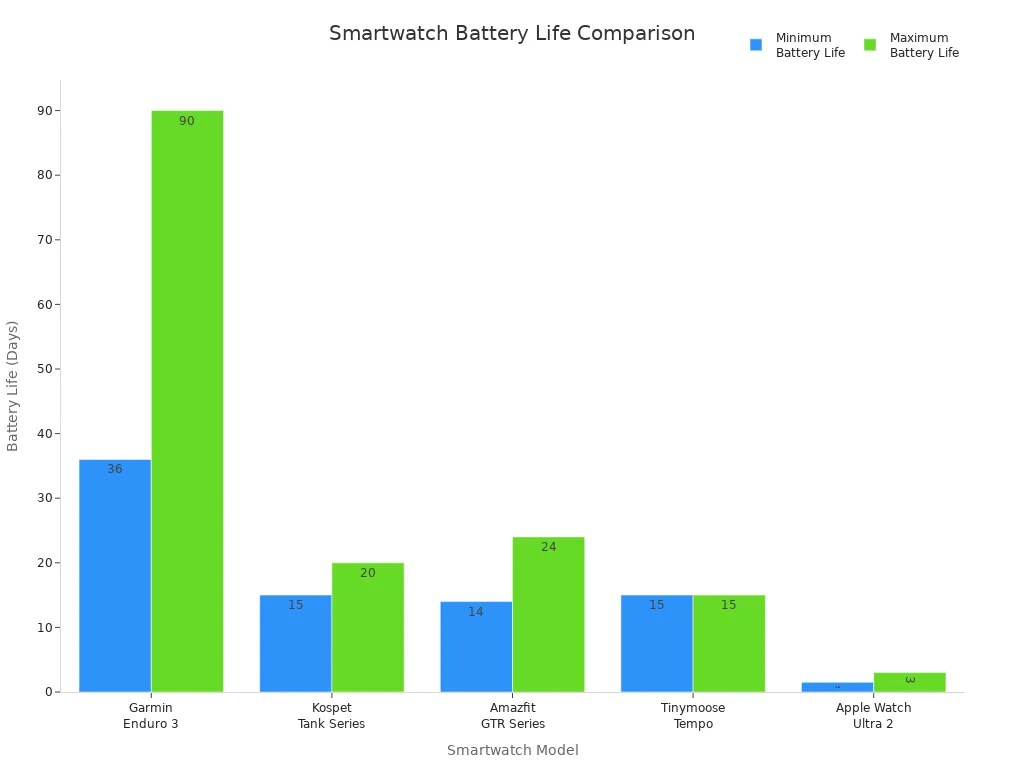
You often wonder how long a smartwatch battery lasts. Most smartwatches run for 1 to 3 days on a single charge. Some models, like Life Watch, stretch battery life up to 7 days. The actual battery life depends on the brand, display technology, and your daily habits. Take a look at this chart to see how different models compare:
You can expect the battery in your smartwatch to last between 2 and 5 years, and careful use may extend this to 7 years. Understanding both daily runtime and overall battery health helps you make the most of your smartwatch.
Smartwatch battery life depends on the model. Most last 1 to 3 days. Some special models can last up to 36 days.
How you use your smartwatch affects battery life. Using fewer features helps the battery last longer. Turning off things you do not need also helps.
The battery usually lasts 2 to 5 years. If you take care of it, it can last up to 7 years.
The screen type is important for battery life. E-Ink screens last the longest. AMOLED and LCD screens use more power.
Check your battery health often. Charge your smartwatch when it is between 20% and 80%. This keeps it working well.
Smartwatch battery life is not the same for every model. Some smartwatches have lots of features. Others are made to last longer. Watches with many features usually need charging every 1 or 2 days. Endurance models can last from 5 to 14 days. A few watches, like Garmin Fenix 7X Pro and COROS Vertix 2, last even longer. You can check the table below to see how each model compares.
Model | Average Daily Runtime per Charge | Type |
|---|---|---|
Garmin Fenix 7X Pro | 37 days in smartwatch mode | Endurance-focused |
Fitbit Versa 4 | 6 days | Feature-rich |
Garmin Vivoactive 4 | 8 days | Feature-rich |
Amazfit GTS 4 | 8 days | Feature-rich |
Polar Grit X Pro | 40 hours with GPS | Endurance-focused |
COROS Vertix 2 | 60 days in regular use | Endurance-focused |
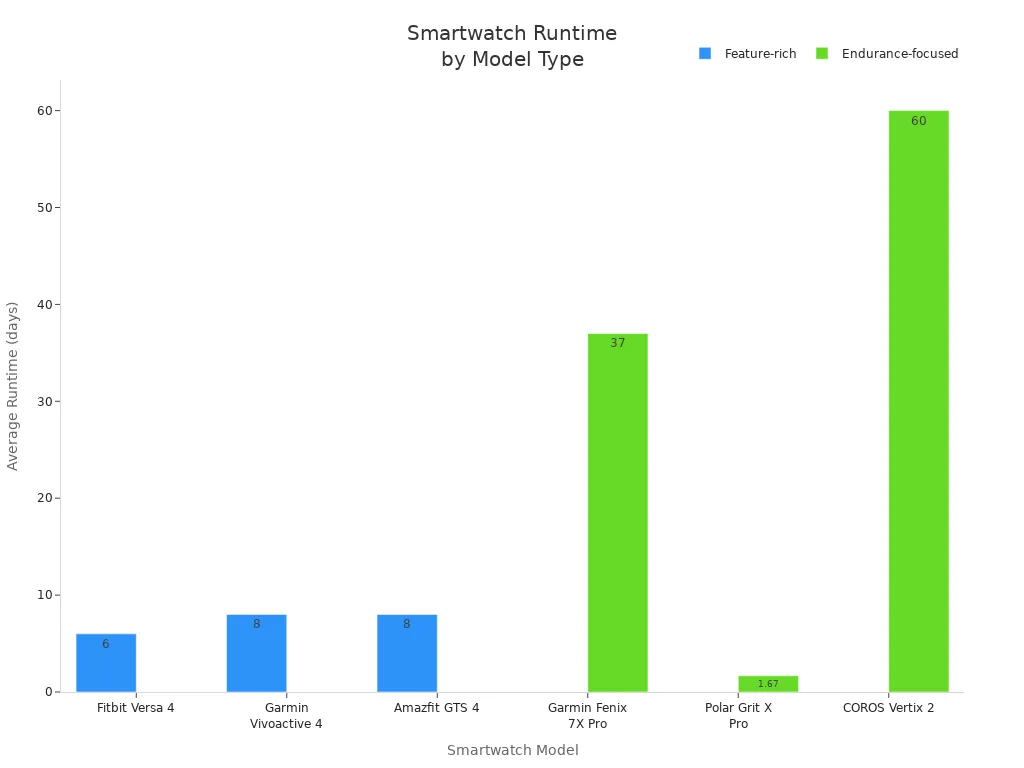
Endurance smartwatches usually last the longest. If you use fewer features, your battery lasts longer. How long your smartwatch lasts on one charge depends on the model and how you use it.
You might ask how long a smartwatch battery lasts. Most batteries work for 2 to 5 years. Careful use can make them last up to 7 years. Batteries get weaker as they get older. You will need to charge your smartwatch more often as time goes by.
All rechargeable batteries get weaker as they age. When lithium-ion batteries get older, they hold less charge. This means you need to recharge your device sooner.
Many things change how long a battery lasts:
Chemical aging makes batteries hold less charge.
Using your smartwatch a lot or charging it often can shorten battery life.
OLED screens use more power than LCD screens.
Fast processors use more energy and drain batteries faster.
Apps running in the background use power.
Bluetooth and Wi-Fi use battery, especially if the signal is weak.
Heart rate sensors and other monitoring features use extra energy.
You can help your battery last longer by using fewer features and charging carefully. If you want your smartwatch to last, pick an endurance model and take care of it. How long your battery lasts depends on how you use and look after your smartwatch.
The type of screen on your smartwatch plays a big role in battery life. Some displays use more power than others. You can see the differences in the table below:
Display Technology | Battery Duration on Single Charge | Key Characteristics |
|---|---|---|
E-Ink | 3 to 5 weeks | Ultra-long battery life, power used only when content changes |
AMOLED | 1 to 7 days | Bright colors, always-on display uses less power than before |
LCD | Varies | Common in cheaper models, uses more energy than e-ink |
E-ink screens help your smartwatch last for weeks. AMOLED screens look bright and colorful, but they use more energy. LCD screens are common in budget models and use more power than e-ink. If you want the best smartwatches for battery life, look for models with e-ink or AMOLED displays.
Tip: Transflective displays also help save battery. They reflect sunlight and use less power outdoors.
The features you use every day can change how long your smartwatch battery lasts. Some features use a lot of energy. For example, GPS tracking, heart rate monitoring, and always-on displays drain the battery quickly. You can see how much each feature affects battery life in the table below:
Feature | Impact Level |
|---|---|
Always-on display | High |
GPS tracking | High |
Heart rate monitoring | Medium |
If you use GPS for a long run, your battery life will drop fast. Heart rate sensors use less power, but they still shorten battery life if you keep them on all day. Basic smartwatches last longer because they have fewer features. Advanced models with health tracking can last longer if you turn off some features.
How your smartwatch connects to your phone or the internet also affects battery life. Bluetooth uses the least power. Wi-Fi uses more, and LTE uses the most. If you turn on LTE, your smartwatch battery drains faster. Some users say their LTE smartwatch lasts only a day, while Bluetooth-only models can last up to two days. Using LTE and Wi-Fi together can make battery life even shorter.
Bluetooth: Least battery drain
Wi-Fi: More battery drain
LTE: Most battery drain, can cause overheating
If you want your smartwatch to last longer, use Bluetooth instead of LTE or Wi-Fi when possible. Choosing the right settings helps you get the most out of your smartwatch battery.
When you shop for a smartwatch, you will see two main types. Some smartwatches have lots of features. These are called feature-rich models. They have bright screens, many apps, and health tracking. You need to charge these watches every day or two. Other smartwatches are endurance models. They last much longer on one charge. Endurance models have simple displays and fewer features. You can use them for weeks before charging.
Here is a table that shows how long each type lasts:
Smartwatch Type | Battery Life (Daily Use) | Special Features |
|---|---|---|
Endurance Champions | Up to 36 days | Solar charging, MIP display |
Rugged Survivors | Up to 15 days | Durability, reliable performance |
Feature-rich models | 1-2 days | AMOLED display, extensive features |
If you want a smartwatch that lasts, pick an endurance model. These watches use less power and work longer than feature-rich ones. If you want more apps and a colorful screen, choose a feature-rich model. But you will need to charge it more often.
Some smartwatches are known for lasting a long time. You can find models that work for weeks on one charge. Here are some of the best smartwatches for battery life:
Garmin Instinct 2 Solar: Lasts up to 28 days.
Amazfit Bip S: Lasts up to 40 days.
Fitbit Inspire 3: Lasts more than a week.
If you want a watch that lasts the longest, try the Garmin Enduro 3. Its battery can last up to 36 days with normal use. It also has solar charging, so you get even more time. Many people say the Enduro 3 works well for long hikes and trips.
Here is a table showing how long the Garmin Enduro 3 lasts in different modes:
Mode | Battery Life |
|---|---|
Smartwatch mode (no tracking) | 36 days |
GPS-only tracking | 120 hours |
All GNSS systems | 80 hours |
Multi-band, all GNSS Systems | 60 hours |
All GNSS systems + music | 22 hours |
Other smartwatches with long battery life are the Kospet TANK series and Tinymoose Tempo. The Kospet TANK series lasts up to 15 days and is tough. The Tinymoose Tempo lasts 15 days and has a bright AMOLED screen.
If you want your smartwatch to last longer, pick an endurance model. These watches give you the best battery life and help you stay connected.
You can get the best longevity from your smartwatch by following a few simple steps. These tips help you extend both daily battery life and the average lifespan of a smartwatch.
Check your battery health. Charge your smartwatch fully, use it for two days, and see how much the battery drops. If you lose more than 35% in one day with the always-on display off and heart rate set to manual, you may need to reset your device.
Reset and recalibrate. Hold the side button for ten seconds until you see the logo. Let the battery drain to zero, then charge it to 100% without stopping.
Turn off non-essential features. Disable SpO₂, stress tracking, and weather sync. Lower the brightness to a medium level. Use Do Not Disturb at night.
Monitor your smartwatch for three days. If the battery lasts at least eight days, you are in good shape. If it lasts less than five days and your smartwatch is over two years old, consider a replacement.
Tip: Avoid buying generic batteries or trying to replace the battery yourself. Many third-party batteries do not last as long as the original.
You can also protect your smartwatch battery by using these habits:
Charge your smartwatch between 20% and 80%. Do not let it drop to zero or stay at 100% for long.
Use the original charger to avoid damage.
Keep your smartwatch away from extreme heat or cold.
Turn off GPS, Bluetooth, or Wi-Fi when you do not need them.
Use low-power mode or turn off your smartwatch when you are not using it.
Here are some settings and habits that help you get the most out of the best smartwatches for battery life:
Recommendation | Description |
|---|---|
Close Unnecessary Apps | Shut down apps you are not using to save power. |
Update Your Smartwatch Software | Keep your smartwatch up-to-date for better battery performance. |
Adjust Vibration Settings | Lower vibration strength to use less energy. |
Monitor Heart Rate Less Often | Set heart rate checks to intervals instead of always-on. |
Turn Off Unused Features | Disable features you do not use every day. |
If you follow these steps, you will notice your smartwatch battery lasts longer each day. You will also help your device last for years. When you ask, "how long does a smartwatch last," remember that your habits make a big difference.
You now know that daily battery life can range from 14 hours to over 30 days, depending on the model and your habits. Factors like always-on display, GPS, and screen brightness have a big impact. To get the most from your smartwatch, adjust settings, close unused apps, and keep your device updated. Think about how you use your watch each day. Choosing the right features and caring for your battery helps your device last longer.
Charge your smartwatch when the battery falls to about 20%. Don’t let it go down to zero or stay at 100% for too long. Charging between 20% and 80% keeps the battery healthy and helps it last longer.
Most smartwatches have batteries built inside that are hard to change. It’s best not to try replacing the battery yourself. Instead, ask the maker or a professional to do it safely and keep the battery working well.
Batteries get weaker as they get older because of chemical changes. After 2 to 5 years, you will see shorter battery life each day. Using many features or charging the watch a lot can make this happen faster. Changing settings can help slow down battery wear.
Yes. Features like GPS, always-on display, and heart rate monitoring use extra power. Turning these off when you don’t need them can make your battery last much longer each day. Use only the features you really need to save energy.
Software updates often make the battery work better and fix problems. Keeping your smartwatch updated helps it run well and can make the battery last longer. But some updates add new features that use more power, so watch your battery after updating.