
Why Evaluate the 502030 Format?
The 20mm × 30mm outline is compact and familiar for a board-side pocket, while the 5.0mm profile can help preserve enclosure height.
3.7 V Lithium Polymer Battery
The 502030 LiPo battery provides a 250mAh rated capacity in a 5.0mm × 20mm × 30mm format. Its approximately 0.93Wh energy reference and 100mΩ listed resistance give OEM teams a thin same-plan-area comparison point for the 300mAh 582030 configuration.

Product Snapshot
The 502030 uses the same 20mm × 30mm plan area as the 582030 but lowers the capacity to 250mAh and the thickness to 5.0mm. It supports a focused capacity-versus-depth decision inside one compact envelope.
The 20mm × 30mm outline is compact and familiar for a board-side pocket, while the 5.0mm profile can help preserve enclosure height.
The 250mAh rating gives approximately 0.93Wh of calculated energy. Compare it with the 300mAh 582030 when the device needs to trade energy against thickness.
Technical Data
The table separates confirmed configuration data from calculated electrical references so the 502030 format can be reviewed quickly during product planning.
| Mechanical and Electrical Specifications | |
|---|---|
| Product number | 502030 |
| Nominal voltage | 3.7 V |
| Rated capacity | 250mAh |
| Battery dimensions | 5.0mm × 20mm × 30mm |
| Approximate battery weight | Approx. 5g |
| C-rate | 1C |
| Internal resistance | 100mΩ |
| Calculated Electrical References | |
| Standard charge current | Approx. 125mA |
| Rapid charge current | Approx. 250mA |
| Standard discharge current | Approx. 50mA |
| Maximum discharge current | Approx. 250mA |
| Calculated energy | Approx. 0.93Wh |
Approximate weight follows the 3.7 V LiPo family reference. Current and energy values are calculated planning references, while internal resistance is a supplied reference; confirm the final charger, protection and load specification for the finished battery.
Product Characteristics & Advantages
The 502030 is positioned around a thin package and a same-plan-area capacity comparison. Its 5.0mm thickness, 250mAh target and 100mΩ listing help design teams decide whether the device values lower depth or additional energy.
The 502030 is positioned around a thin package and a same-plan-area capacity comparison. Its 5.0mm thickness, 250mAh target and 100mΩ listing help design teams decide whether the device values lower depth or additional energy. The calculated electrical references provide a structured starting point for charger, load and protection discussions, while the final battery remains a configurable OEM design.
The fixed outline can simplify comparison with the 582030 and preserve a concentrated battery bay near the PCB.
The thinner profile can create more room for board components, housing features or user-facing surfaces.
The calculated energy supports early runtime and recharge comparison for compact tracking, handheld and medical products.
The listed resistance gives the electrical team a direct input for startup and voltage-drop questions.
The derived mass supports a preliminary portable-device budget; final leads, protection and connector details remain configuration-specific.
Battery Calculation
Use the prefilled 502030 values or enter your own load assumptions for a quick energy and runtime estimate.
Energy is calculated from nominal voltage and capacity. Runtime uses the entered load power and an adjustable efficiency assumption.
Approx. 125mA is the approximate standard-charge reference for 250mAh.
The 502030 reference values are prefilled: 3.7 V, 250mAh and a standard-charge reference of approximately 125mA. Adjust the load power and efficiency to compare operating scenarios; the calculator does not infer safe limits from capacity alone.
Use the result for early comparison, then confirm the charger, protection, connector and final battery specification through sample testing.
Integration Guidance
The 502030 is most useful when the product team can hold the 20mm × 30mm plan area constant and decide whether a 5.0mm, 250mAh configuration or a 5.8mm, 300mAh configuration better fits the product.
Use the 20mm × 30mm outline to compare the two capacity configurations without redesigning the battery bay.
Reserve cushioning, retention and connection space so the thin cell is not compressed by the enclosure.
Approximately 0.93Wh is lower than the 582030 reference, so compare the capacity difference with runtime and recharge expectations.
The 100mΩ value supports early voltage-drop screening, but the final current path must include the device load, wires, connector and protection.
Applications & Solutions
The 502030 can be evaluated in compact products where the 20mm × 30mm pocket is already defined and the design prioritizes a thin 5.0mm package over the maximum energy in that outline.
 01
The 5mm × 20mm × 30mm format can be assessed in compact POS terminals where a thin battery must support display, payment and communication electronics.
View POS Machine Battery Solutions → 02
The 250mAh reference can be compared with compact security-camera layouts where a shallow pocket must balance standby duration, radio activity and enclosure clearance.
View Security Camera Battery Solutions → 03
The 20mm × 30mm plan area gives portable-networking teams a compact reference for reviewing radio bursts, backup runtime and the battery channel.
View WiFi Router Battery Solutions →Related Technical Articles
These guides help compare a thin same-plan-area battery through energy density, current demand and temperature considerations.
 Energy Planning
Compare 0.93Wh and 1.11Wh within the same 20mm × 30mm plan area.
Read the energy planning guide → Current Demand
Use the 100mΩ listing to frame the load and charger discussion.
Read the current demand guide → Operating Conditions
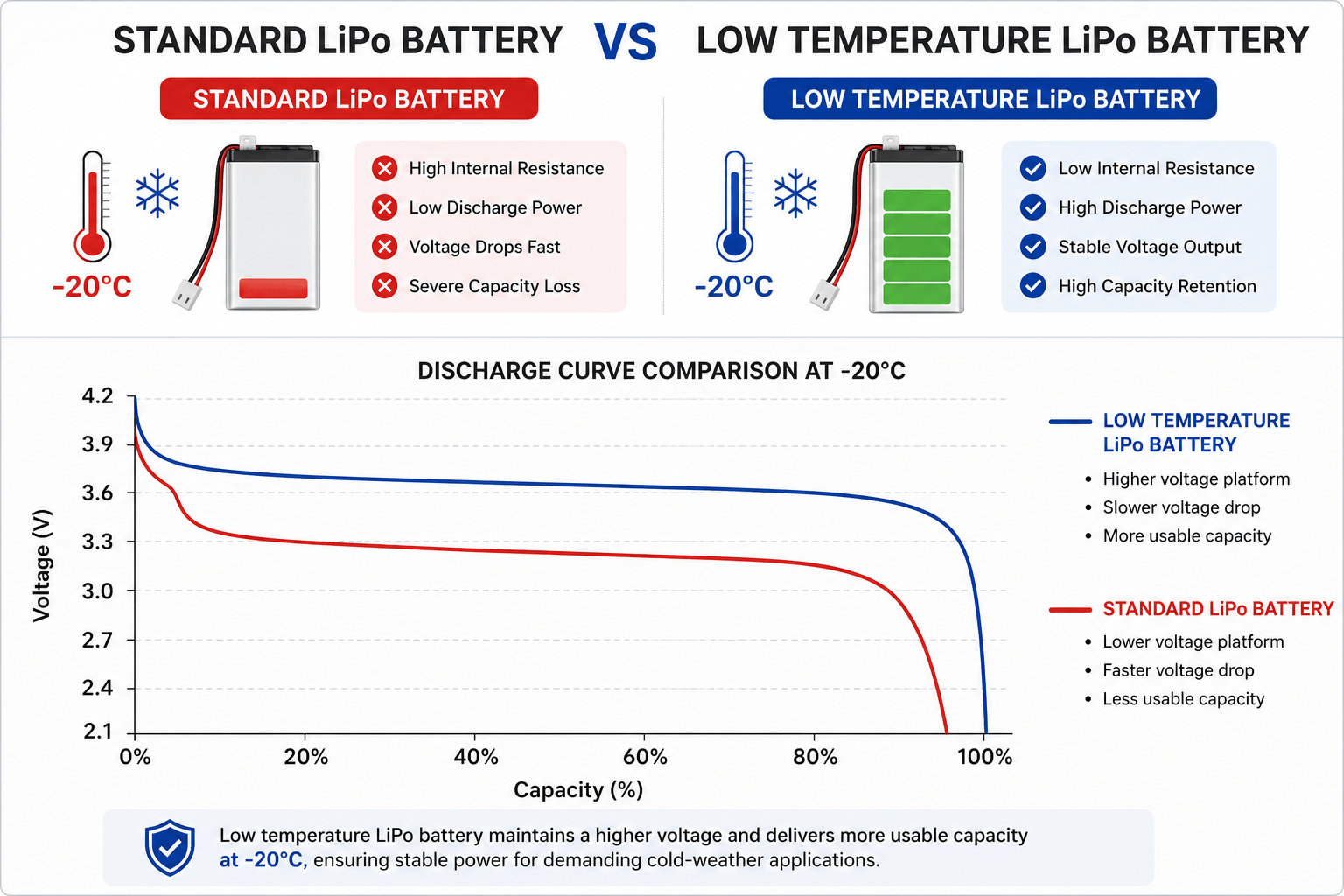
Review thermal behavior when the cell sits in a shallow compact enclosure.
Read the operating conditions guide →OEM Battery Support
Share the 20mm × 30mm battery bay, available depth, target runtime and load profile so ZERNE can compare the 250mAh and 300mAh configurations directly.
The most useful RFQ keeps the pocket fixed and explains whether thinness or energy reserve is the primary design priority.
ZERNE can compare the 582030 300mAh configuration, a narrow 250mAh format or a custom geometry when the 502030 tradeoff is not enough.
Discuss a Custom BatteryFAQ
Find answers about the 502030 3.7 V 250mAh lithium polymer battery, including its thin same-plan-area relationship with 582030, calculated energy and resistance.
The 502030 reference is specified as 5.0mm × 20mm × 30mm in thickness × width × length order. Allow additional room for cushioning, retention, leads, connector and protection.
The rated capacity is 250mAh at a nominal voltage of 3.7 V. The calculated energy is approximately 0.93Wh before cutoff, load, temperature, resistance, protection and system losses.
Using the 3.7 V LiPo family weight reference, the 250mAh configuration is approximately 5g. Finished weight depends on leads, connector, protection and assembly details.
The calculated current references are approximately 125mA standard charge, 250mA rapid charge, 50mA standard discharge and 250mA maximum discharge. Confirm the final safe limits for the completed battery.
Both references use a 20mm × 30mm plan area. The 502030 is 5.0mm thick and 250mAh, while 582030 is 5.8mm thick and 300mAh, so they represent a capacity-versus-depth choice.
The 5.0mm thickness can preserve enclosure height when the 0.93Wh calculated energy is sufficient for the device duty cycle.
Technical Inquiry
Share the fixed 20mm × 30mm pocket, available depth, operating interval and load profile so the 250mAh format can be compared with the 300mAh option.